Introduction
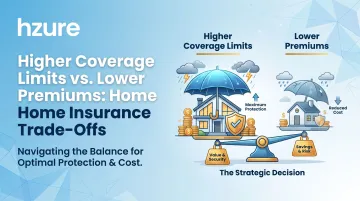
Every Danish homeowner faces a fundamental dilemma: pay higher premiums for comprehensive coverage, or accept the risk that a major claim could cost far more than the savings. Both choices carry real financial consequences. Overpaying drains your budget year after year, while underinsurance leaves you exposed to costs that dwarf whatever you saved on premiums.
The Danish insurance industry makes this comparison deliberately difficult. 57% of homeowners are unsure exactly what their policy covers, according to Guardian Service's 2025 consumer insight survey, and among those who claim to understand their coverage, 77% still take a hands-off approach to managing it.
That's not accidental. Complex policy language, opaque pricing structures, and loyalty surcharges create conditions where most homeowners either overpay for coverage they don't need or stay dangerously underinsured without realizing it.
This guide breaks down the actual trade-offs — what higher coverage limits cost you, what lower premiums risk, and how to find the right balance for your household.
Key Takeaways
- Higher coverage limits provide stronger financial protection when disaster strikes, but increase your annual premium
- Lower premiums shrink monthly costs while quietly creating coverage gaps — particularly when limits haven't kept pace with Denmark's rising construction costs
- The right choice depends on your home's current rebuild value, emergency savings, local risk exposure, and whether your premium reflects current market rates from Danish carriers
- Many Danish homeowners simultaneously overpay and remain underinsured — a sign they've never benchmarked their policy against the real market
- Knowing the trade-off matters — but acting on it, by checking what your policy actually costs versus what it should, is what changes your situation
Higher Coverage Limits vs. Lower Premiums: At a Glance
- Cost: Each coverage tier jump carries a real price — Forbrugerradet Taenk's analysis found going from 200,000 to 1,000,000 DKK raises premiums ~20%; from 1,000,000 to 2,000,000 DKK adds another 31%.
- Lower premiums come from four levers: reduced coverage limits, higher deductibles, fewer covered perils, or actual cash value instead of replacement cost.
- Protection gap: Lower-premium policies cap payouts below true rebuild costs, leaving you to cover the shortfall out of pocket.
- Risk exposure: Coastal and west-Jutland homeowners face outsized weather risk — 131,000 weather claims totaling 4.6 billion DKK were filed over just 2.5 years.
- Higher coverage suits: homeowners with limited savings, high-value properties, or frequent weather exposure.
- Lower premiums suit: those with strong cash reserves, genuinely low-risk locations, and recently verified coverage limits.
What Are Higher Coverage Limits?
Coverage limits define the maximum amount your insurer will pay for covered losses across each category: dwelling (building structure), personal property (contents), liability protection, and additional living expenses during repairs. These limits are set when you purchase your policy and create the ceiling of your financial protection.
Four key coverage components:
- Dwelling coverage (husforsikring): Rebuilding costs for the physical structure
- Personal property (indboforsikring): Contents, valuables, and belongings
- Liability protection (ansvarsforsikring): Legal costs and injury claims
- Additional living expenses: Temporary housing during repairs
Each component carries individual limits that can be set at different levels, making side-by-side policy comparisons harder than they should be.
The underinsurance risk:
When coverage limits fall below actual rebuild costs, you face a gap where insurance pays less than true recovery expenses. This problem has intensified as construction costs have risen sharply. Statistics Denmark's Construction Cost Index shows increases since 2021 ranging from 9% (painting) to 24% (electrical work), with most trades up 20-21%.
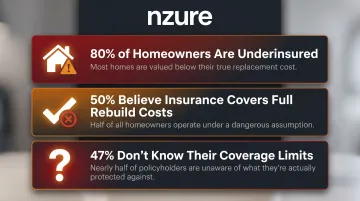
Research suggests this is widespread: approximately 80% of homeowners are estimated to be underinsured, yet 50% believe their insurance will cover full rebuilding costs. Even more concerning, 47% don't know their coverage limits at all.
Replacement cost vs. actual cash value:
These two coverage types determine how insurers calculate payouts:
- Replacement cost: Pays full rebuild or replacement costs using materials of similar quality, without deducting for depreciation
- Actual cash value: Deducts depreciation based on age and wear, resulting in significantly lower payouts
Budget policies often use actual cash value to reduce premiums — a distinction insurers rarely explain clearly at the point of sale.
Use Cases of Higher Coverage Limits
Understanding how coverage types work makes it easier to spot where higher limits are worth the extra cost. Here are the situations where they matter most:
- High-risk weather zones: Denmark's west coast of Jutland, North Funen, the South Sea Islands, and Bornholm see the highest claims frequency per capita. These areas recorded unusually high weather damage during 2023-2024, Denmark's wettest years on record.
- Older homes: Properties built decades ago require full replacement at today's material and labour costs — not 1990s construction prices. The gap between those two figures has grown sharply.
- High-value personal property: Collections, art, jewellery, electronics, and specialty items need adequate sum-insured amounts to avoid out-of-pocket losses at claim time.
- Limited emergency savings: If absorbing a 10,000-20,000 DKK unexpected expense would be a serious strain, higher coverage limits are a practical safeguard.
Concrete scenario:
A homeowner purchased their property in 2015 for 2,500,000 DKK and set dwelling coverage at that amount. A major fire occurs in 2026. Rebuild costs have increased approximately 20% since purchase due to construction cost inflation.
The actual rebuild cost is now 3,000,000 DKK, but the policy limit remains at 2,500,000 DKK. That 500,000 DKK shortfall comes entirely out of pocket — and dwarfs any premium savings from leaving coverage limits unchanged since 2015.
What Does Choosing Lower Premiums Actually Mean?
"Lower premiums" doesn't simply mean a cheaper version of identical coverage. It represents a fundamental transfer of financial risk from the insurer back to you, achieved through one or more of four mechanisms.
The four levers that reduce premiums:
- Reduced coverage limits: Lower maximum payouts across dwelling, contents, or liability
- Higher deductibles (selvrisiko): Greater out-of-pocket costs before insurance coverage begins
- Fewer covered perils: Named-perils policies (covering only listed events) vs. all-risk policies (covering everything except specific exclusions)
- Actual cash value: Depreciation-adjusted payouts instead of full replacement cost

Each lever reduces your premium by shifting more financial exposure to you.
The deductible mechanism:
Your deductible is the amount you pay before insurers contribute. Forbrugerradet Taenk found that raising deductibles from 0 DKK to 3,000 DKK reduces average premiums by 24.4%, while increasing from 3,000 DKK to 5,000 DKK provides another 9.5% reduction.
A customer choosing a 5,000 DKK deductible might save 30% annually — but faces 5,000 DKK out-of-pocket per claim. After two claims in five years, those deductible costs can wipe out every kroner saved on premiums.
Hidden exclusions in budget policies:
Lower-premium policies often exclude specific perils or add separate deductibles for high-risk events. Texas Department of Insurance notes that named-perils policies (which are cheaper) cover only specifically listed events, while all-risk policies cover everything except stated exclusions.
Common hidden exclusions include:
- Storm surge damage (handled through Denmark's Natural Hazards Council, not private insurance)
- Mould removal
- Foundation repair
- Sewer backups
None of these show up in a headline premium comparison — yet each can turn a manageable claim into a five-figure out-of-pocket bill.
The loyalty tax problem:
Inzure's analysis shows Danish insurers typically charge approximately 2,400 DKK more annually after 10 years of loyalty compared to new sign-ups for equivalent coverage. Unlike deliberately choosing a lower-premium policy, this is passive value erosion: your costs rise while your coverage stays flat — or quietly shrinks.
Use Cases of Lower Premiums
Lower premiums can be reasonable in specific, limited circumstances:
- Strong emergency savings: You hold 50,000+ DKK in accessible savings and can cover a high deductible without financial strain
- Genuinely low-risk location: Your property has no history of costly claims and minimal exposure to weather events, flooding, or theft
- Recently verified coverage: You've confirmed your limits accurately reflect current rebuild costs and property values within the past 12 months
Cautionary scenario:
A homeowner chooses a lower-premium policy with a 5,000 DKK deductible to save 1,800 DKK annually. Three years later, a storm causes 75,000 DKK in damage. Here's how the numbers land:
- Deductible cost: 5,000 DKK out-of-pocket
- Coverage shortfall: 15,000 DKK (policy caps payout at 60,000 DKK)
- Total out-of-pocket: 20,000 DKK
That single claim costs more than 11 years of premium savings (1,800 DKK × 11 = 19,800 DKK).
Higher Coverage Limits vs. Lower Premiums: What's Actually Better?
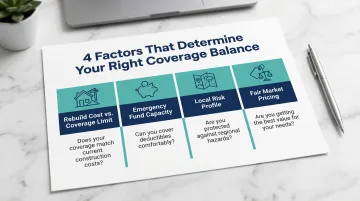
The right balance depends on four critical variables, not a universal formula.
Four decision factors:
- Current rebuild cost vs. dwelling coverage limit: Has your coverage kept pace with construction cost inflation?
- Emergency fund capacity: Can you absorb out-of-pocket costs without financial hardship?
- Local risk profile: Weather frequency, theft rates, proximity to flood or fire hazards
- Fair market pricing: Is your current premium competitively priced, or inflated by loyalty surcharges?
Situational guidance:
Choose higher coverage limits if:
- Your home's rebuild value has risen significantly since you last reviewed limits
- You live in a high-risk coastal or weather-exposed area of Denmark
- You have limited savings to cover large deductibles
- Your coverage is based on purchase price rather than current rebuild cost
Consider lower premiums only if:
- You've verified limits are accurate within the past year
- You maintain substantial cash reserves (50,000+ DKK readily available)
- You're in a genuinely low-risk location with no claims history
- You're making a conscious, informed choice — not defaulting to the lower number without verification
Why "coverage vs. cost" is the wrong question:
Most homeowners assume they must choose between being well-covered and being affordable. The real problem is often that they're paying too much for insufficient coverage — not that good coverage is inherently unaffordable.
Most Danish households take a "set it and forget it" approach to their policies, which allows insurers to raise prices on loyal customers while offering competitive rates to new sign-ups. Market benchmarking — comparing your premium against current equivalent coverage — is the step most homeowners overlook.
Simple decision checklist:
- Does your dwelling coverage limit reflect today's rebuild cost (not purchase price)?
- Can you cover your deductible without financial hardship?
- Have you compared your premium against current market rates in the past 12 months?
- When did you last review your personal property coverage limits?
- Are you in a high-risk area that justifies higher coverage limits?
If you can't answer "yes" to the first three questions, start there — those gaps are where most Danish households either overpay or find themselves underinsured when it matters.
How to Stop Overpaying Without Sacrificing Protection
The goal isn't picking the cheapest policy or the most comprehensive one in isolation. It's paying a fair market price for the right level of coverage for your specific home.
The core principle:
Most homeowners have never verified whether their current policy is correctly priced and correctly structured. This creates a situation where you can simultaneously overpay AND remain underinsured — a common pattern in the Danish market.
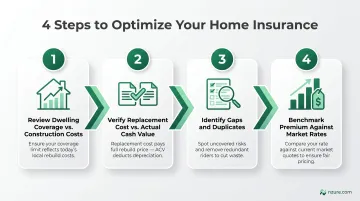
Practical steps to optimize coverage and cost:
Review dwelling coverage against current construction costs: Use Statistics Denmark's Construction Cost Index as a benchmark. If your policy was set more than 2-3 years ago, rebuild costs have likely increased 15-25%.
Verify replacement cost vs. actual cash value: Confirm your policy uses replacement cost coverage, not depreciation-adjusted actual cash value. This distinction determines whether you receive full rebuild costs or reduced payouts.
Identify coverage gaps and duplicates: Common gaps include missing bicycle theft coverage (cykeltyveri), missing legal aid protection (retshjælp), and inadequate sum-insured for valuables. Common duplicates include travel insurance already covered by credit cards or public health cards.
Benchmark your premium against real market rates: Compare what you're paying against equivalent coverage from Tryg, Topdanmark, Alka, Codan, and other Danish carriers. Loyal customers often pay 2,400 DKK more annually than new sign-ups for identical coverage.
Inzure automates this entire review in 60 seconds. Upload your policy document (PDF or photo), and the platform identifies gaps, overlaps, and whether you're paying above market rate — with no obligation to switch providers.
Annual review as a habit:
Running this analysis once is a good start. Making it annual is what prevents the problem from returning. Coverage needs shift as home values, construction costs, and personal property evolve — a well-calibrated policy from 2023 may be both overpriced and underprotective in 2026.
Forbrugerradet Taenk recommends reviewing coverage when moving, having children, when children move out, or after major renovations. Building an annual check prevents both loyalty premium creep and silent underinsurance.
Frequently Asked Questions
How do coverage limits affect homeowners insurance premiums?
Higher coverage limits increase premiums because insurers take on greater financial exposure per claim. Conversely, lower limits reduce premiums but cap recovery amounts. The key is ensuring limits match your actual rebuild cost, not an arbitrary lower figure based on an outdated purchase price.
What happens if my home insurance coverage limit is too low?
If a covered loss exceeds your coverage limit, you pay the difference out of pocket. This underinsurance is particularly common when homeowners set limits based on purchase price rather than current rebuild cost, which industry estimates suggest has risen 15–25% across Danish construction trades in recent years.
Is it worth paying higher premiums for more home insurance coverage?
For most homeowners, yes. A single major claim can cost far more than years of accumulated premium savings, making adequate limits a better financial bet than chasing the lowest possible price. Your rebuild exposure, emergency savings, and local risk profile all shape where the right balance sits.
What is the difference between coverage limits and deductibles in home insurance?
A coverage limit is the maximum your insurer pays on a claim. A deductible (selvrisiko) is the amount you pay out-of-pocket before insurance contributes. Both affect your premium and financial exposure, but in different ways — limits cap total protection, while deductibles determine your immediate costs per claim.
How do I know if I'm underinsured on my home insurance?
Key warning signs include: dwelling coverage based on purchase price rather than current rebuild cost, actual cash value instead of replacement cost coverage, or no limit review since major renovation or construction cost inflation. If any apply, you're likely underinsured.
Can I lower my home insurance premium without reducing coverage?
Yes. Several approaches can reduce your premium without cutting protection:
- Install home security systems to qualify for safety discounts
- Remove duplicate coverage you're paying for across multiple policies
- Benchmark your current premium against real market rates to spot overcharging
- Note that bundling isn't always cheaper in Denmark — individual policies often win on price