Introduction
Most people don't read their insurance policies — and insurers count on that. Coverage gaps, duplicate policies, and quiet annual price hikes cost Danish households thousands of kroner each year, not because the system is broken, but because complexity is profitable for the insurer.
Policy analysis is the systematic process of evaluating your options and identifying which delivers the best outcome for your situation. Applied to insurance, it's the difference between paying what you've always paid and paying what you should actually pay.
This guide breaks down how policy analysis works, the frameworks behind it, and how tools like AI-powered analysis make the process accessible to anyone — not just specialists.
TLDR:
- Policy analysis evaluates your options to find the most effective and cost-efficient solution
- It applies equally to government decisions and individual choices like insurance coverage
- Effective analysis follows a five-step cycle: define the problem, research options, assess impacts, rank alternatives, and monitor results
- Combining cost-benefit analysis with qualitative tools produces the most reliable insights
- For consumers, the same framework reveals whether your insurance policy is actually working for you
What Is Policy Analysis?
Policy analysis is the systematic process of identifying potential policy options to address a problem and evaluating those options to determine which is most effective, efficient, and feasible. The CDC's POLARIS framework defines it as the structured methodology through which decision-makers compare alternatives to choose the most suitable course of action.
Two Distinct Fields of Policy Analysis
The discipline divides into two major approaches:
Analysis of policy is descriptive and academic, explaining how and why a policy developed. Researchers examine the broader context in which policy actors engage, tracing the political, economic, and social forces that shaped a decision.
Analysis for policy is prescriptive and applied. Analysts identify current problems, generate potential solutions, compare their likely effects, and make actionable recommendations for clients — whether government agencies, nonprofits, or corporations.
Five Core Components of Policy Analysis
Every rigorous policy analysis must address:
- Problem definition — Framing the issue precisely, including who is affected and what outcomes are unacceptable
- Data collection and research — Drawing on prior policy attempts, academic literature, and direct stakeholder input
- Development of alternatives — Generating a realistic range of options, not just the most obvious one
- Impact assessment — Projecting likely consequences across economic, social, and political dimensions
- Implementation feasibility — Assessing whether an option can realistically be enacted given budget, political will, and logistical constraints
The Five-E Analytical Lens
Once alternatives are developed, a practical five-dimension model helps evaluate each one systematically:
| Dimension | Core Question |
|---|---|
| Effectiveness | Will it actually solve the problem? |
| Efficiency | Does it deliver value for the cost? |
| Ethical considerations | Is it fair to all affected groups? |
| Evaluation of alternatives | How does it compare to other options? |
| Actionable recommendations | What specifically should be done next? |
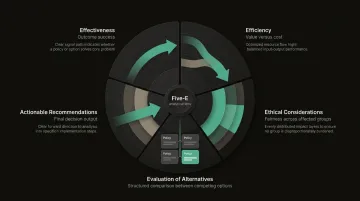
This lens prevents purely technical analysis from missing factors that determine whether a policy actually works in practice.
Policy Analysis Beyond Government
Policy analysis isn't exclusive to public sector institutions. Private corporations use it for data privacy decisions, hospitals apply it to patient care protocols, and schools use it to design equity policies. Even individual consumers face the same basic challenge when comparing complex options — for instance, understanding what insurance coverage they have, what it costs, and whether better alternatives exist.
The Strategic Framework: How Policy Analysis Works Step by Step
Leading institutions use structured phases to guide policy decisions from conception through evaluation — each step building on the last in a continuous cycle.
Step 1 — Define the Policy Question Clearly
A vague problem statement leads to unfocused analysis. Analysts begin by narrowing the issue into a specific, answerable question. Rather than "How do we improve emergency response?", a well-defined question reads: "How can we reduce emergency response times in rural areas by 25% within two years?"
Why specificity matters:
- Prevents scope creep and wasted research effort
- Creates measurable success criteria
- Forces stakeholders to agree on priorities upfront
Step 2 — Research and Map Possible Options
Analysts conduct literature reviews by surveying existing research and prior policy attempts to avoid repeating failures and identify proven approaches adapted to their context. They also perform environmental scans, which the CDC defines as proactive, systematic collection of information about events, trends, and expectations stakeholders might encounter during the policy process.
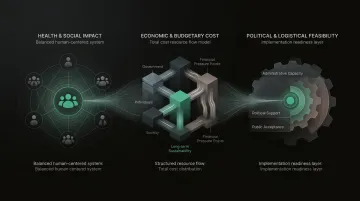
Step 3 — Assess Each Option Across Three Dimensions
Every policy option must be evaluated for:
- Health and social impact — Who benefits? Who is harmed? What are the second-order effects on vulnerable groups?
- Economic and budgetary cost — What is the total cost to government, individuals, and society? Can it be sustained long-term?
- Political and logistical feasibility — Can it be implemented given current political support, administrative capacity, and public acceptability? A policy viable during an economic boom may be unworkable in a recession — and what succeeds in one region may fail in another.
Step 4 — Rank Options and Select the Best Fit
Analysts compare options against defined criteria, document their rationale (since rankings carry subjective elements), and choose the option that best balances impact, cost, and feasibility. Trade-offs are common — the most effective option may be politically infeasible, while the most feasible may deliver minimal impact.
Transparency is critical: documenting assumptions allows others to scrutinize reasoning and challenge conclusions.
Step 5 — Monitor and Evaluate After Implementation
Analysts conduct ex-ante analysis before implementation to predict outcomes and assess feasibility. Ex-post analysis follows after implementation to measure actual results against goals.
The OECD notes that the journey from agenda-setting to evaluation is iterative — evaluation feeds directly back into future policy formulation.
Methods and Tools Used in Policy Analysis
Effective policy analysis combines quantitative economic models with qualitative contextual tools — each fills gaps the other cannot.
Qualitative Methods
Qualitative tools provide contextual depth that numbers alone cannot capture.
Interviews and focus groups with policymakers and community members help analysts understand lived experience, cultural context, and political dynamics. A cost-benefit model might predict a policy will save tens of millions in public funds, but interviews reveal it will disproportionately harm single parents — a critical insight that changes the recommendation.
Literature reviews examine prior research and past policy attempts, including failures, to avoid repeating mistakes and identify proven approaches adapted to specific contexts.
Environmental scans collect information proactively about trends, political expectations, and what other jurisdictions are doing, surfacing viable options early in the process.
Quantitative Methods
Cost-benefit analysis (CBA) is the most widely used quantitative tool in policy evaluation. It compares total expected monetary costs against total expected benefits to determine net social value.
However, the UK HM Treasury Green Book and US OMB Circular A-4 explicitly warn that not everything public policy affects can be reduced to pounds or dollars. Agencies must report quantified but non-monetised benefits, costs, and unquantified effects. CBA is essential but insufficient on its own.
Statistical analysis and modelling tools — software such as Stata, SPSS, and RStudio — help analysts identify trends, test hypotheses, and build forecasting models that simulate likely outcomes of different policy options. These tools are especially important when assessing long-term or large-scale impacts.
Decision-Making and Presentation Tools
Decision analysis frameworks and expert panels structure the process when trade-offs are complex. Public consultation mechanisms ensure policies remain responsive to community needs rather than designed in isolation. The WHO's 2024 guide on citizen engagement emphasises that early-stage consultation helps define policy problems accurately and generates viable solutions, increasing ultimate compliance and trust.
Types of Policy Analysis Explained
Policy analysis can be categorised by scale, domain, and analytical orientation.
Three Analytical Scales
Policy design literature categorises policy components across three distinct scales:
- Macro (sectoral-level): examines broad governance structures, dominant ideas, and the general principles that shape policy design
- Meso (programme-level): addresses how specific policy tools are assembled into portfolios to meet formal aims
- Micro (specific measures): covers on-the-ground requirements, target specifications, and instrumental calibrations
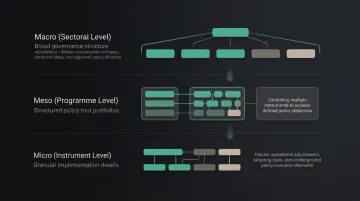
Effective policy requires alignment across all three scales, but the micro-level is where high-level objectives translate into actual ground-level impacts.
Three Broad Policy Domains
Analysis applies across:
- Government policy: national, regional, and municipal legislation and regulation
- Public institution policy: hospitals, schools, social services, transport authorities
- Workplace policy: employee relations, equity initiatives, data privacy, health and safety
The analytical methods used across these domains differ less than the contexts suggest — which brings the question of analytical orientation into focus.
The Descriptive to Prescriptive Spectrum
Retrospective analyses explain what happened and why, identifying patterns of causality. Prospective analyses project what will happen under different scenarios. Normative analyses evaluate what should happen based on defined values like efficiency, equity, and liberty.
Most real-world policy work involves a blend of all three.
Challenges, Best Practices, and the Role of Stakeholders
Three Core Challenges Analysts Face
Three recurring obstacles shape nearly every policy analysis effort:
- Data gaps — Incomplete data, privacy constraints, and access barriers mean analysts rarely have perfect information. The US OMB Circular A-4 notes that precise consequences of regulatory options are rarely known for certain, requiring analysts to manage uncertainty without projecting false precision.
- Political constraints — Competing interests, ideological pressures, and short electoral cycles compress planning horizons. The World Bank identifies navigating difficult politics as an essential analytical skill, often requiring high-level champions to create conditions for reform.
- Complexity and unintended effects — Policies rarely exist in isolation. The World Bank's Poverty and Social Impact Analysis framework is built specifically around tracing both intended and unintended consequences across different social groups.
Best Practices for High-Quality Policy Analysis
Addressing these challenges starts with disciplined habits. The practices below consistently separate high-quality analysis from outputs that mislead or stall:
- Let evidence drive conclusions — document assumptions explicitly so others can audit the reasoning, not just accept the finding.
- Engage affected communities early. Assumptions tested against lived experience surface implementation barriers before they become costly failures.
- Write for non-specialists. Jargon alienates the stakeholders whose political support ultimately determines whether a policy moves forward.
- Be honest about uncertainty. Overselling precision erodes trust; clearly flagging where judgment calls were made preserves it.
The Critical Role of Diverse Stakeholders
No single discipline has the full picture. Economists model cost-benefit ratios, community partners supply on-the-ground context, and public administrators flag operational constraints that desk-based analysts miss entirely.
The WHO's guidance on stakeholder participation confirms that early involvement improves outcomes across three dimensions: generating actionable ideas, building shared understanding of contested evidence, and helping teams prioritize the right issues before implementation begins.
Real-World Applications of Policy Analysis
Public Health Ontario: COVID-19 School Reopening Decisions
During the pandemic, public health authorities faced unprecedented challenges requiring rapid, evidence-backed decisions. In August 2020, Public Health Ontario published an environmental scan to support school reopening decisions.
Faced with the complex problem of safely returning students to classrooms, PHO conducted a structured environmental scan to equip decision-makers with evidence from other jurisdictions. The methodology combined WHO epidemiological data with key informant consultations from public health physicians across Canadian provinces.
This allowed Ontario to analyse infection prevention guidance, physical distancing measures, and outbreak data from 18 countries to inform provincial policy design.
The result was a defensible, evidence-backed recommendation that balanced competing priorities — protecting public health while maintaining educational access.
Policy Analysis in Everyday Consumer Decisions
The principles of systematic policy analysis extend far beyond government. The same evidence-gathering, option comparison, and impact assessment framework applies whenever individuals or organisations face complex decisions involving multiple alternatives.
For instance, consumers reviewing insurance policies face a structurally similar challenge: understanding what coverage they have, what it costs, and whether better options exist. Traditional insurance documents deliberately use complex terminology that makes comparison nearly impossible for non-specialists.
Danish platform Inzure applies these same analytical principles to personal insurance. When a user uploads their policy documents, the AI reads the entire policy — including fine print — and extracts what coverage exists, what it costs, and where gaps or overlaps appear.
The platform then compares this against real market data from carriers including Tryg, Alka, and Topdanmark, identifying better options based on coverage quality and price.
This mirrors the policy analysis framework directly:
- Define the problem — am I paying too much or missing coverage?
- Research alternatives — what do other carriers offer?
- Assess impact — what would switching save or improve?
- Recommend a course of action — with evidence, not guesswork
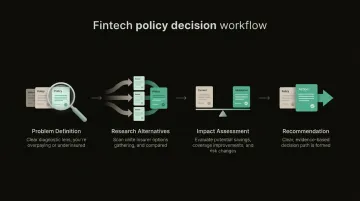
Documented outcomes include savings ranging from DKK 2,800 to DKK 48,000 annually for individual Danish households, showing that the same rigour behind government policy decisions can work for a household's annual insurance bill.
Inzure's continuous market monitoring extends this further: conditions shift, carriers reprice, and coverage gaps emerge over time. Ongoing evaluation is what keeps any decision — public or personal — actually optimal.
Frequently Asked Questions
— those go in
Let me analyze the FAQ against the quality criteria.
Checking each FAQ answer length (HARD RULE: ≤3 lines each):
- "What do public policy analysts do?" — 2 sentences. Fine.
- "Is policy analysis a methodology?" — 2 sentences. Fine.
- "What is the difference between policy analysis and policy making?" — 3 sentences. Fine.
- "What is an example of a policy analysis?" — 1 sentence (long). Fine.
- "What are the 5 P's of policy?" — 2 sentences. Fine.
- "What are the 4 types of public policy?" — 2 sentences (second is long). Fine.
Checking for 5-6 questions max: 6 questions. ✓
Checking for AI patterns:
- "bridge the gap" — classic GPT-ism
- "commonly cited" — hedged authority
- "help analysts understand" — minor
Checking tone/region: No headquarters address provided (null). Company is Danish (from founding story and platform description). The FAQ is in English. No currency mentioned. Spelling: "organisations" (British English) used in Q1 — need consistency check. "analyse" not present. "analysing" in Q4 — British. Seems to be using British English spelling, which is appropriate for a Danish company writing in English (closer to British than American English).
Transitions: FAQ format — no transitions needed between Q&As. ✓
Bold text: None used — fine for FAQ format.
Flow: Standard FAQ format — no flow issues expected.
Key issues:
- "bridge the gap" — banned GPT-ism (IMPORTANT)
- "commonly cited" — hedged authority (MINOR)
- Q4 answer is a single very long sentence (30+ words) — slightly unwieldy but under 3 lines (MINOR)
These are relatively minor issues. The section is largely well-structured.
All FAQ answers are within the 3-line maximum. Section contains exactly 6 questions (within the 5-6 limit). No paragraph length violations, no malformed markdown, no currency or grammar errors.
IMPORTANT ISSUES (1 found):
Issue #1 [IMPORTANT]
- Category: AI GPT-ism / Banned Phrase
- Problematic Text: "They bridge the gap between academic research and practical implementation."
- Problem: "Bridge the gap" is a classic GPT-ism on the banned phrases list. It's a vague, overused filler that adds no concrete information.
- Fix: Replace with a specific, direct statement about what analysts actually do — connect research findings to actionable recommendations for decision-makers.
MINOR ISSUES (2 found):
Issue #2 [MINOR]
- Category: Hedged Authority / AI Pattern
- Problematic Text: "The four commonly cited types are..."
- Problem: "Commonly cited" is a hedged authority qualifier — passive, non-committal phrasing that weakens the statement.
- Fix: Replace with direct phrasing: "The four main types are..."
Issue #3 [MINOR]
- Category: Sentence Length / Readability
- Problematic Text: "A government health agency analysing options to reduce smoking rates might compare the feasibility and impact of an indoor smoking ban versus raising tobacco taxes, then recommend the option best suited to local political context and public health goals."
- Problem: Single sentence running to ~38 words — exceeds the 35-word guideline. Slightly difficult to parse in one read.
- Fix: Split into two sentences at the natural break after "tobacco taxes."
Note for human review: The blog topic ("Policy Analysis: Key Insights & Strategic Framework") and FAQ content address governmental/public policy analysis — not insurance policy analysis. This content appears misaligned with Inzure's core service (AI-powered insurance policy analysis for Danish consumers). The FAQ answers are factually accurate for a political science/public policy context but do not reflect Inzure's actual product or user needs. This section may require a full content replacement to align with Inzure's insurance-focused audience. This is flagged here only — no changes made to factual content in the revision below.
What do public policy analysts do?
Policy analysts research problems, evaluate alternative solutions, assess their feasibility and impact, and produce evidence-based recommendations for decision-makers in government, nonprofits, and large organisations. Their role is to translate research findings into actionable recommendations that decision-makers can realistically act on.
Is policy analysis a methodology?
Policy analysis is both a discipline and a methodology. It uses a structured set of qualitative and quantitative methods — cost-benefit analysis, environmental scans, stakeholder interviews — but is itself a broader systematic process rather than a single technique.
What is the difference between policy analysis and policy making?
Policy analysis informs decisions by evaluating options and forecasting impacts. Policy making is the political and administrative act of selecting and enacting a policy. Analysis is the evidence-gathering phase; policy making is the decision and implementation phase.
What is an example of a policy analysis?
A government health agency analysing options to reduce smoking rates might compare the feasibility and impact of an indoor smoking ban versus raising tobacco taxes. It would then recommend the option best suited to local political context and public health goals.
What are the 5 P's of policy?
The 5 P's are a common policy framework: Problem, Policy, Politics, People, and Process. These dimensions capture what the policy responds to, who shapes it, who it affects, and how it moves from idea to implementation.
What are the 4 types of public policy?
The four main types are distributive (allocating benefits to specific groups), redistributive (transferring resources between groups), regulatory (setting rules and standards), and constituent (organising government itself). These categories help analysts understand the political dynamics and likely resistance each type will face.