Introduction
Most Danish families have no idea what their insurance policies actually say—and that gap can be expensive. Coverage limits, exclusions, duplicate coverage, and unjustified price increases are buried in dense legal language most people never read.
According to EIOPA's Consumer Trends Report, 71% of EU consumers find insurance policies have vague terms and unclear coverage. Another 12% say pre-contractual information doesn't give them enough to make informed decisions.
This guide covers how AI tools for insurance document analysis work, what they can realistically uncover, and how to choose one. It's written for everyday policyholders — not insurance professionals.
Key Takeaways
- AI tools read insurance documents in seconds, pulling out coverage details, exclusions, and pricing automatically
- The biggest value is discovering coverage gaps, duplicate policies, and loyalty-driven price increases hiding in your current plan
- The best tools are insurer-independent, GDPR-compliant, and built for people with no insurance expertise
- Inzure gives Danish consumers a full AI policy analysis in 60 seconds — no commitment to switch required
What Is AI Document Analysis in Insurance?
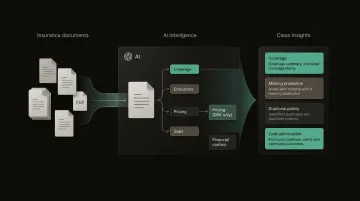
AI document analysis is software that reads insurance PDFs like a trained expert would: identifying what's covered, what's excluded, what you're paying, and whether the terms are fair. Instead of spending hours decoding 32-page policy documents filled with legal terminology, you upload a PDF and receive a plain-language breakdown in under a minute.
The underlying technology is called Intelligent Document Processing (IDP). It uses Natural Language Processing (NLP) and machine learning to extract structured data from unstructured documents like policy PDFs, declaration pages, and coverage summaries — without needing perfect formatting.
The AI recognizes key data fields (premium amounts, coverage limits, deductibles, exclusions, renewal dates) and converts dense policy language into clear, side-by-side information anyone can act on.

Enterprise vs. Consumer Tools
There's a critical difference between enterprise tools and consumer-facing tools:
- Enterprise tools are built for insurance companies and adjusters to process thousands of claims, automate underwriting, and manage high-volume workflows
- Consumer-facing tools are built to help individual policyholders understand and optimize their own coverage without requiring insurance expertise
The tools covered in this guide are consumer-focused platforms designed to give you transparency and control over your insurance decisions.
What AI Tools Actually Uncover in Your Insurance Documents
Most people assume their policies are fine — until they're not. AI analysis surfaces the specific problems that manual review typically misses:
Coverage Gaps
AI cross-references what your policy covers against common risk scenarios for your profile. It surfaces situations where you're exposed but think you're protected—such as a home policy that excludes water damage from burst pipes, or a travel policy that voids coverage if you forgot to register a pre-existing condition. For example, Inzure identified a Danish customer who had been without home insurance coverage for at least 10 years despite believing she was protected.
Duplicate Coverage
Many households unknowingly pay for the same coverage across multiple policies. AI flags these overlaps, pinpointing exactly where you're doubling up. One Inzure customer discovered duplicate travel insurance coverage across multiple policies, plus unnecessary charges for a newborn who should have been covered free until age two.
Loyalty Penalty and Unjustified Price Increases
Insurance companies routinely raise premiums for existing customers without improving coverage. The UK's Financial Conduct Authority found that in 2018, 6 million loyal policyholders would have saved £1.2 billion had they paid the average price for their actual risk.
The pattern holds in Denmark too. After 10 years with the same insurer, a customer can pay 2,400 kr more per year for identical coverage — a 50% price increase with nothing to show for it. AI tools compare your current premium against real market rates, showing exactly what new policyholders pay for the same protection.
Exclusion Clauses and Fine Print
The most costly parts of a policy insurers often bury in exclusion language. AI highlights the specific clauses that limit or void coverage under conditions you might reasonably expect to be covered. A common example: activity exclusions in accident insurance that void payouts if the injury occurred during an unlisted sport — details most people never read until it's too late.
How AI Insurance Document Analysis Works
How Documents Are Processed
The process begins when you upload your insurance policy PDFs or declaration pages to the platform. No special format is required: the AI handles scanned documents, digital PDFs, and multi-page policy packets.
The extraction layer uses NLP models to read the text, identify key data fields (premium, coverage limits, deductibles, exclusions, renewal dates), and convert unstructured policy language into structured, comparable data. This includes exclusion clauses, sub-limits, and renewal conditions that most policyholders never read closely enough to catch.
How Analysis and Comparison Happen
Once data is extracted, the AI benchmarks it against market data: comparing your coverage terms and pricing to flag what's overpriced, missing, or out of step with comparable policies.
Inzure performs this analysis in 60 seconds by reading and analyzing insurance documents across all Danish insurers. The platform delivers a complete policy breakdown and market comparison instantly, without requiring any insurance knowledge from the user.
The output: A clear, plain-language report showing:
- What you currently have
- What you're missing
- Where you're overpaying
- What your policy should realistically cost in today's market

Key Benefits for Everyday Insurance Customers
Time Savings
Traditional policy review requires hours of reading fine print, comparing policies manually, and decoding insurance terminology. Inzure compresses what used to take 10 hours into a 60-second process — no phone calls, no forms, no back-and-forth with agents.
Financial Savings
Danish customers have saved between 2.800 kr and 48.000 kr annually after AI analysis surfaced loyalty penalties and coverage inefficiencies they had no idea existed. The financial gains come from knowing the specifics:
- Whether your current premium is priced fairly against the market
- Whether duplicate policies are quietly draining your budget
- Whether a coverage gap could cost you far more at claim time
Peace of Mind Through Ongoing Monitoring
Static policy reviews go out of date. AI tools that monitor your policies continuously alert you when something changes—a premium increase, a coverage change at renewal, or a better market option—so you're never caught off-guard. You're only notified when there's something actionable to address, not bombarded with constant alerts.
What to Look for When Choosing an AI Insurance Document Tool
Independence and Neutrality
The tool should have no financial relationship with any specific insurer. Tools tied to insurance companies have an incentive to steer you toward their products, not toward the best option for you. Look for explicitly independent platforms that work for you, not insurance companies.
Data Privacy and GDPR Compliance
Your insurance documents contain sensitive personal and financial data. EIOPA warns that if a dataset contains sensitive data that cannot be separated, processing is prohibited under GDPR Article 9(1) unless strict derogation applies, such as explicit consent.
Confirm that any tool:
- Stores data within the EU
- Operates under GDPR with mandatory Data Protection Impact Assessments
- Does not sell or share your data with insurers or third parties
Inzure, for example, meets all three criteria: data is stored in EU infrastructure, the platform charges no hidden fees, and user data is never shared with insurers unless you explicitly request a switch and grant permission.
Ease of Use and No Commitment Required
The best tools are built for ordinary users, not insurance professionals. Look for platforms that:
- Require no prior insurance knowledge to navigate
- Produce plain-language output you can actually act on
- Let you upload policies and receive a full analysis before committing to anything
You should be able to see results and decide whether to act—without pressure to switch or sign up.
Frequently Asked Questions
What is the AI tool for analyzing documents?
AI document analysis tools use Natural Language Processing to read and extract structured information from unstructured documents like insurance PDFs. They identify key terms, prices, and conditions automatically, converting complex policy language into plain-language summaries you can understand.
What is intelligent document processing for insurance?
IDP combines Optical Character Recognition (OCR), Natural Language Processing, and machine learning to convert insurance documents into structured, analyzable data. This enables automatic extraction of coverage details, exclusions, premiums, and policy terms at scale—turning static PDFs into actionable insights.
What types of insurance documents can AI analyze?
AI tools can process policy PDFs, declaration pages, renewal notices, terms and conditions documents, and coverage schedules across home, travel, accident, liability, and other insurance types. Most platforms accept both digital PDFs and scanned documents and photos.
Is it safe to share my insurance documents with an AI tool?
Look for GDPR compliance, EU data storage, no data sharing with third parties, and independence from insurance companies. These features provide the strongest privacy safeguards for your sensitive information.
How accurate is AI analysis of insurance policies?
Accuracy depends on the NLP model quality and the breadth of insurance-specific training data. OCR can achieve 98-99% accuracy digitizing text, but interpreting legal clauses is less precise. Leading consumer tools perform well on standard policy formats, though results vary by document complexity.
Can an AI tool replace a professional insurance advisor?
AI tools are best for understanding what you have, whether it's fairly priced, and identifying gaps or duplicates. For complex or unusual situations, professional advice is still worth considering.