
Introduction
In Denmark, most people pay more for insurance than they should — and never find out. Insurance policies are built around fine print, layered jargon, and renewal letters that make it nearly impossible to know whether your premium is fair or your coverage is adequate. That complexity isn't incidental. It's how the industry has operated for decades. Comparing policies manually takes hours, requires specialist knowledge, and still frequently leaves consumers paying too much for too little.
In Denmark, the cost of this complexity is staggering. Consumers overpay by an average of €44 (19% of their premium) on home contents insurance due to sub-optimal decisions. Nearly 20% of young Danish adults (18-30) lack home contents insurance entirely, leaving them financially vulnerable.
This article breaks down what AI-powered insurance comparison tools actually do, the concrete advantages they deliver, and what staying passive costs you.
Key Takeaways
- AI tools analyze existing policies and compare them against the full market in seconds
- They detect coverage gaps, duplicate policies, and unfair price increases manual reviews miss
- Consumers using these tools can cut premiums by up to 46% without reducing coverage quality
- The core advantage is independence — these tools have no financial relationship with any insurer, so recommendations reflect your interests
- Real value compounds through continuous monitoring, not one-time comparison
What Is an AI-Powered Insurance Comparison Tool?
An AI-powered insurance comparison tool is a digital platform that reads, interprets, and analyzes insurance policies — then benchmarks them against current market offerings — without requiring you to understand the underlying complexity.
How consumers use these tools:
- Upload or connect existing policy documents (PDFs, scanned photos)
- AI extracts key data points: premiums, coverage limits, exclusions, deductibles
- Platform runs structured comparison across multiple insurers simultaneously
The goal is real clarity: whether your current insurance is priced fairly, structured correctly, and free from costly gaps or overlaps — not just another list of quotes.
Inzure runs this full analysis in 60 seconds, handling the reading and cross-referencing that would otherwise take hours on your own.
Key Advantages of AI-Powered Insurance Comparison Tools
The advantages below are grounded in practical outcomes — cost, coverage quality, time, and confidence that your coverage won't fail when you need it. Each advantage reflects a real problem that traditional comparison methods fail to solve.
Policy Transparency: Seeing What You're Actually Paying For
Most consumers have never fully read their insurance policies — not because they're lazy, but because policies are written to be difficult. AI tools solve this by reading and summarizing what the policy actually covers, what it excludes, and where critical gaps exist.
How it works in practice:
The AI ingests policy documents (PDFs, scanned files, or direct data connections), extracts structured information on:
- Coverage types
- Exclusions
- Deductibles and limits
- Unusual terms or missing protection
It then flags anything unusual — such as missing liability coverage, underinsured assets, or duplicate coverage across multiple policies.
Why this matters:
Coverage gaps cost consumers significantly when a claim is denied or only partially paid. The percentage of general liability claims closed without payment across EU member states — including Danish policyholders — jumped from 8% in 2020 to 19% in 2021. A policy that looks affordable can carry hidden gaps that result in far greater out-of-pocket costs at claim time.
Real-world example:
An 86-year-old Inzure customer discovered she had no home contents insurance for at least 10 years. Another customer found his newborn was being charged for coverage that should have been free, and his partner wasn't covered on three critical policies. These aren't edge cases — they're what happens when policies go unexamined.
KPIs impacted:
- Coverage adequacy
- Claim success rate
- Out-of-pocket exposure at claim
- Duplicate spend eliminated
When this advantage matters most:
Critical when you haven't reviewed policies in over 12 months, have experienced a life change (new home, new family addition), or hold multiple policies across different insurers.
Market Benchmarking: Knowing the Real Price of Your Insurance
Without a comparison, you have no reference point for whether your current premium is fair. Insurers rely on this — renewing loyal customers at inflated rates while offering new customers competitive pricing.
How AI creates this advantage:
The tool aggregates real-time or near-real-time market pricing data across multiple insurers, normalizes it by coverage type, and shows you where your current policy sits relative to the market.
The loyalty penalty is real:
Danish consumers with 10+ years at the same insurer pay an average of 425 DKK more annually for car insurance, 240 DKK more for home contents, and 443 DKK more for house insurance compared to new customers with identical coverage. On average, a customer with 10 years' seniority pays a margin 7-8 percentage points higher than a new customer. For home and house insurance, the highest loyalty penalties reach 30-35 percentage points at certain companies.

Why this matters:
Knowing the real market price is the only way to negotiate, switch, or validate that staying with your current insurer is the right choice — without pressure from an agent who earns commission on the outcome.
KPIs impacted:
- Annual premium cost
- Premium reduction percentage on switch
- Time-to-comparison decision
When this advantage matters most:
At renewal time, after any significant price increase notification, and for consumers who have been with the same insurer for more than two years.
Continuous Monitoring: Staying Optimized Beyond a One-Time Check
A single comparison gives a snapshot of the market at one point in time. AI tools that offer continuous monitoring automatically track price movements, new market entrants, and policy changes — alerting you when a materially better deal becomes available.
How continuous monitoring works:
The platform maintains a live or periodically updated view of market conditions for your specific risk profile. It sends alerts when:
- Your premiums drift above market rate
- A new product becomes available that better fits your coverage needs
- Insurer terms are updated at renewal without clear notification
Why this matters:
Insurance markets shift regularly — new insurers enter, rates adjust, and coverage products improve. A consumer who compared once two years ago is no longer optimized. EIOPA has identified "price walking" practices — where premiums are repeatedly increased at renewal based on a customer's low propensity to shop around — as leading to unfair treatment and non-compliance with the Insurance Distribution Directive.
The result is a sustained reduction in overpayment year over year, not just a one-time saving.
KPIs impacted:
- Annual premium saved over time
- Number of renewal cycles where overpayment was avoided
- Alerts acted on per year
When this advantage matters most:
Especially valuable for consumers with multiple policies — home, travel, accident, liability, or family coverage — and anyone who has experienced an unexplained premium increase at renewal.
What Happens When AI Comparison Tools Are Not Used
Skipping AI comparison tools doesn't just mean missing a deal — it means paying for gaps, duplicates, and inflated premiums that stay invisible until something goes wrong:
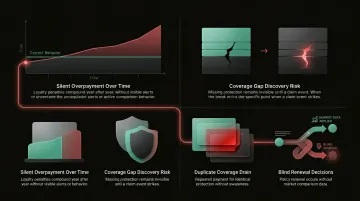
Silent overpayment builds year over year. Most consumers never switch insurers unless forced to — so loyalty penalties quietly compound. 41% of EU consumers didn't compare insurance offers at all when purchasing or renewing; in Sweden, 59.8% considered zero alternatives.
Coverage gaps surface at the worst moment. Without structured policy analysis, missing coverage only becomes obvious when a claim is denied. 22% of EU consumers are unsure whether their policy covers natural catastrophe events — a gap that costs nothing to find but everything to discover after the fact.
Duplicate coverage drains household budgets unnoticed. Separate contents and home policies, overlapping travel coverage — households with multiple providers frequently pay twice for identical protection and never realize it.
Renewal decisions happen blind. Without current market data, the choice to stay or switch is based on habit, not information — made under time pressure with no way to know whether the price is fair.
How to Get the Most Value from AI Insurance Comparison Tools
AI comparison tools deliver the most value when used as an ongoing practice rather than a one-off task:
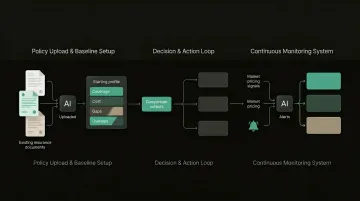
Upload your existing policies first. Establish a baseline — know what you currently have, what it costs, and where the gaps or overlaps are before comparing market alternatives.
Act on the output. A comparison result is only useful if it leads to a decision: switching, renegotiating, or filling a coverage gap. Use it as a starting point, not a final answer.
Enable continuous monitoring. Platforms like Inzure offer ongoing market surveillance that automatically flags when your premiums drift above market rate or a better-matched product becomes available — so you never have to check manually.
Conclusion
AI-powered insurance comparison tools do more than surface a cheaper quote. They give consumers something the traditional insurance model was never designed to provide: a clear, independent picture of what they're actually paying for and whether it's fair.
The benefits build on each other over time. Transparency stops you from paying for the wrong coverage. Market benchmarking stops you from overpaying for the right one. And ongoing monitoring makes sure neither problem creeps back in.
Platforms like Inzure were built precisely on this premise — that Danish consumers deserve the same information advantage that insurers have always kept to themselves. The tools now exist to close that gap. Using them is simply a matter of knowing they're there.
Frequently Asked Questions
What are the advantages of digital insurance comparison platforms?
Digital platforms compare multiple insurers in seconds rather than hours, provide transparency on both price and coverage quality, and detect gaps or overpayment that manual research almost always misses.
What should I look for when comparing insurance on digital platforms?
Prioritize platforms that are independent (not tied to specific insurers), analyze coverage quality and not just price, and offer ongoing monitoring rather than a one-time quote.
How is AI insurance comparison different from using a traditional broker?
A broker typically earns commission from insurers and may have limited carrier access, whereas an AI-powered independent platform analyzes the full market without financial incentive to favor any particular insurer.
Is my data safe when using an AI insurance comparison platform?
Look for platforms that store data on EU-compliant servers and adhere to GDPR as a minimum standard. Inzure, for example, keeps all data on EU-compliant servers with no exceptions.
Can an AI tool identify if I'm paying too much for my current insurance?
AI tools benchmark your current premium against real market pricing for equivalent coverage, making it clear whether you are paying above, at, or below the market rate.
How often should I use an AI insurance comparison tool?
Review at every renewal and after any significant life change — new home, new vehicle, or growing family. A platform with continuous market monitoring removes the need to remember to check at all.