

Insurance comparison tools solve this by consolidating multiple quotes or policy analyses into one place, saving consumers hours of research and potentially thousands of kroner in annual premiums. The best tools go beyond surface-level price comparisons to identify coverage gaps, duplicate policies, and the loyalty tax many insurers quietly impose on long-term customers.
Key Takeaways
- Insurance comparison tools let you view and analyze options without contacting each insurer individually
- The best platforms identify coverage gaps, duplicate policies, and loyalty-based price hikes — not just show prices
- Many "comparison" sites are lead-generation platforms that sell your data — not tools that show real quotes
- AI-powered tools like Inzure analyze existing policies and detect overpayments in under 60 seconds
- What separates good tools from bad: insurer independence, data privacy, and how deep the analysis actually goes
What Are Insurance Comparison Tools — And Why Do They Matter?
Insurance comparison tools are digital platforms or apps that allow consumers to view, compare, or analyze insurance policies and pricing from multiple providers in one place. They eliminate the need to contact insurers individually, request separate quotes, and manually compare fine-print terms across dozens of pages of policy documents.
Two Distinct Types of Tools
The comparison tool market splits into two fundamentally different categories:
Real-quote platforms display live, personalized pricing from partner insurers based on your specific situation. These platforms have direct integrations with insurance companies and show actual premiums you would pay if you purchased through them. They typically operate as licensed intermediaries regulated by financial authorities.
Lead-generation sites collect user data and sell it to insurers, brokers, or third-party marketers — often without showing accurate quotes at all. In the US market, Consumer Reports found in 2025 that some lead-generation platforms sell consumer data for less than $1 (USD) to hundreds of dollars per lead.
One submission alone generated "thousands of phone calls for months, if not years."
This distinction matters for privacy, quote accuracy, and whether you'll be bombarded with spam after entering your details.
What Separates Good Tools from Mediocre Ones
The European Insurance and Occupational Pensions Authority (EIOPA) established a framework for evaluating comparison websites in 2014, identifying six critical dimensions:
- Market coverage disclosure: Does the tool clearly state how many and which insurers it compares?
- Conflicts of interest: Is the platform affiliated with or incentivized by specific insurers?
- Ranking transparency: Are "best buy" labels based on the entire market or only paying partners?
- Data practices: Does the platform comply with GDPR and protect user information?
- Analysis depth: Does it audit existing policies or only show new quotes?
- Accessibility: Are results presented in clear language with all fees disclosed?
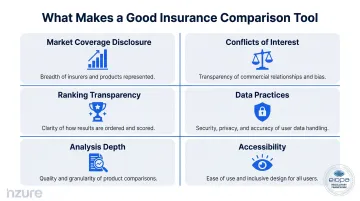
Platforms that score well across all six dimensions give you an accurate picture of the market. Those that score poorly on independence or data practices — especially ranking transparency — are likely optimizing for their own revenue, not your coverage.
Best Insurance Comparison Tools in 2026
The following tools were evaluated on independence, real-quote capability, depth of analysis, ease of use, data privacy practices, and market relevance.
Inzure
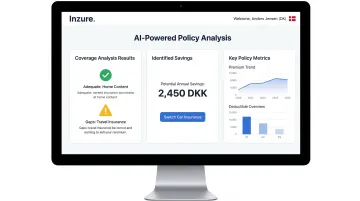
Inzure is Denmark's first AI-powered, independent insurance platform built specifically for Danish consumers who want full transparency into what they're paying and why. Rather than generating new quotes from scratch, Inzure analyzes your existing policies — identifying coverage gaps, duplicate insurance, and loyalty-based price hikes in under 60 seconds.
The platform reads and analyzes policies across all major Danish insurers, including Tryg, Topdanmark, Alka, Codan, GF, Alm. Brand, If, and Lærerstandens Brandforsikring. It monitors the market continuously, not just at renewal time, so you're never paying more than necessary.
There's no upfront cost: Inzure takes only 20% of confirmed savings if a better deal is found. All data is stored on EU servers in full GDPR compliance, and Inzure has no affiliation with any insurance company.
Danish users have saved between 2,800 kr and 48,000 kr annually. Two examples from real users:
- Hans Henrik Beck, 62 — saved 48,000 kr per year (a 46% reduction) after eight years with Tryg
- Lise Nielsen, 86 — saved 2,800 kr annually and improved her coverage after Inzure discovered she'd been without home contents insurance for over a decade
| Attribute | Details |
|---|---|
| Key Feature | AI-driven policy analysis in 60 seconds — scans existing coverage for gaps, overlaps, and overpayments |
| Pricing Model | Free to use; 20% of first-year savings only if a better deal is found — no binding or obligation |
| Data & Privacy | GDPR-compliant EU data storage; not affiliated with any insurer; no hidden fees |
Compare the Market
Compare the Market is a well-established UK-based comparison platform that allows consumers to compare quotes across home, car, life, travel, and business insurance from a wide panel of insurers. It is one of the most widely used tools in the UK insurance