Introduction
Policies — whether government regulations, institutional rules, or insurance contracts — are rarely as neutral or straightforward as they appear. Most are shaped by values, power structures, and competing interests that a surface-level reading will miss. Research from the late 1980s revealed that traditional policy evaluation methods treated policies as objective, value-neutral documents, ignoring the inequalities baked into their design from the start. This shift toward critical analysis transformed how experts evaluate everything from education legislation to consumer insurance policies.
This article walks through the key frameworks analysts use for critical policy analysis. Whether you're reviewing government legislation, workplace policies, or a home insurance contract, these frameworks reveal who benefits, who gets left out, and why policies are framed the way they are.
TLDR
- Critical policy analysis interrogates who benefits, who is excluded, and why a policy was framed this way — not just whether it achieves stated goals
- Frameworks covered: policy trajectory, policy actor analysis, and a four-pillar model (influences, texts, implementation, privileges)
- Traditional analysis treats implementation as success; critical analysis treats power, rhetoric, and equity as equally important
- Applied to real documents, these frameworks surface hidden gaps, overlaps, and structural unfairness that passive reading misses
What Is Critical Policy Analysis?
Defining Policy Broadly
Policy isn't just laws or regulations. It's any formal or informal set of rules, intentions, and values that govern how a system handles a problem. Frances C. Fowler defines public policy as "the dynamic and value-laden process through which a political system handles a public problem," including both expressed intentions and consistent patterns of activity and inactivity.
This broad definition matters because it expands where critical analysis applies. You're not limited to government legislation — corporate contracts, institutional rules, and consumer-facing agreements like insurance policies all qualify as policy documents worth interrogating.
Critical vs. Traditional Policy Analysis
Traditional policy analysis systematically compares and evaluates alternatives for solving public problems. It measures outcomes, tracks implementation, and determines whether stated goals were achieved.
Critical policy analysis asks fundamentally different questions. As Sue Winton defines it, CPA is "a body of research undertaken by scholars and activists in the pursuit of social justice." Rather than accepting policy goals at face value, critical analysts interrogate:
- Who shaped the policy and whose voices were excluded
- Whose definition of the problem won out
- Who benefits from the policy versus who is left out
The Emergence of Critical Policy Analysis
CPA emerged in the late 1980s and early 1990s as a direct reaction against positivist policy science traditions that assumed policy analysis could be purely objective and rational. Foundational authors like Stephen J. Ball and Catherine Marshall challenged this assumption, arguing that policies always reflect power dynamics and value judgments — whether policymakers acknowledge it or not.
Seemingly neutral policies frequently reproduce existing inequalities. Measuring implementation success without examining who designed the policy, whose problem definition prevailed, and who gains access misses the most consequential questions.
The Policy Window Concept
Policies don't always emerge from rational planning. Political scientist John Kingdon introduced the "policy window" concept: policies open when three separate streams converge : a recognized problem, available policy proposals, and favorable political forces such as a change in administration or a shift in public opinion.
This explains why many policies feel reactive rather than comprehensive. They emerge not from careful design but from opportunistic alignment of circumstances. Critical analysis asks whether this rushed convergence left out important voices or baked in avoidable flaws.
Why This Matters Beyond Academia
These frameworks aren't confined to academic research — they apply anywhere complex documents govern people's lives. When you review a workplace policy, read legislation affecting your community, or try to understand your insurance contract, critical analysis helps you spot what a surface read misses: the assumptions embedded in language, the interests served by specific framings, and the gaps that leave certain groups unprotected.
Traditional vs. Critical Policy Analysis: Key Differences
How Each Approach Measures Success
The two approaches define "success" very differently — and that difference shapes everything from research questions to reform recommendations.
| Dimension | Traditional Analysis | Critical Analysis |
|---|---|---|
| Starting question | Did the policy achieve its stated goals? | Who shaped the policy, and who does it serve? |
| Definition of success | Efficient implementation of stated objectives | Equitable outcomes across all affected groups |
| Treatment of values | Value-neutral; goals taken as given | Values are examined as part of the analysis |
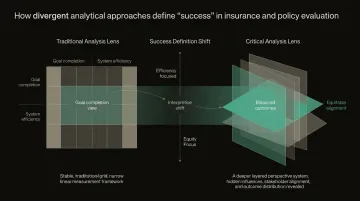
A policy that achieves stated goals but systematically disadvantages certain groups is not considered successful under critical frameworks — even if every implementation target was met.
The Difference in Handling Policy Rhetoric
Traditional analysis takes stated policy goals at face value. If a policy claims to "improve attendance," traditional analysis measures whether attendance increased.
Critical analysis examines the language itself as a clue to underlying values and assumptions. The shift from "achievement gap" to "opportunity gap" language illustrates this perfectly. Gloria Ladson-Billings' research demonstrates that "achievement gap" focuses on outputs (test scores) and promotes deficit orientations toward marginalized students, locating the problem in individuals rather than structures.
"Opportunity gap" reframes the same disparity around inputs — the unequal distribution of resources — and shifts reform responsibility from individuals to systems. The language used to define a problem determines which solutions appear reasonable and which go unquestioned.
The Innovation-Policy Gap
Policymakers consistently struggle to keep up with technological, social, and economic change. Research from the SAIS Review identified this as the "innovation-policy gap": the speed of technological progress has generated a dangerous gap in dialogue between innovators and policymakers.
Traditional analysis asks whether a policy is outdated. Critical analysis asks who benefits from the delay in updating it. When regulation lags behind market innovation, certain actors gain advantages while others face increased risk. The OECD's 2025 Regulatory Policy Outlook notes that regulators often adopt a "regulate-and-forget mindset" — by the time problematic areas are identified, technologies have already evolved, making meaningful control challenging.
Key Frameworks Used in Critical Policy Analysis
Sabatier's Framework Concept
Policy frameworks are analytical structures made up of descriptive categories and constructs that map relationships between variables. They give analysts a consistent vocabulary and method for diagnosing what a policy does and how it works.
Paul Sabatier's Advocacy Coalition Framework focuses on how policy subsystems evolve through the interaction of advocacy coalitions bound by shared belief systems. These coalitions engage in policy-oriented learning over a decade or more. Meaningful policy change, in this view, requires sustained effort across shifting political contexts.
Policy Cycle: Actors, Contexts, and Trajectory
Policy Actors
Stephen Ball and colleagues identified that the individuals responsible for receiving, enacting, championing, or resisting a policy within an institution fundamentally shape outcomes. The same policy can produce radically different results depending on who is enacting it and in what context.
Ball's typology includes narrators, entrepreneurs, outsiders, transactors, enthusiasts, translators, critics, and receivers. Each role represents a distinct mode of interpreting and translating policy texts into practice.
Policy Trajectory
Policies are not static documents. Once written, they are interpreted, adapted, contested, and sometimes transformed through enactment. The written text may contain contradictions, omissions, or ambiguities that shape how it lands in practice. A policy's trajectory traces this evolution from initial design through implementation and beyond.
Policy Contexts
Three key contexts shape a policy's life:
- Context of influence — Who shapes the discourse around a problem and what solutions seem reasonable?
- Context of text production — Who is included or excluded as a stakeholder during drafting?
- Context of practice — How well is the policy received, and how open to interpretation is it in real settings?
Ball's model treats these contexts as overlapping but independent arenas that interact but don't perfectly align, explaining why policies often fail to achieve stated goals despite technically correct implementation.
The Critical Policy Analysis Framework (Four Pillars)
The four-pillar framework organises critical analysis into four diagnostic categories:
Policy Influences: Belief systems, assumptions, and who holds traditional power in shaping the policy agenda
Policy Texts: Legislation, rhetoric, discourse, and media pronouncements — the actual language and framing used
Policy Implementation: Actors, levers, contexts, and whether implementation produces compliance or resistance
Policy Privileges: Who has access, who benefits, who is marginalised, and equity implications
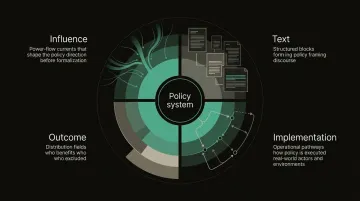
Each pillar generates targeted diagnostic questions that move analysis beyond surface evaluation:
- Under Policy Influences: "Whose voices shaped this policy? Whose perspectives were excluded?"
- Under Policy Texts: "What assumptions are embedded in this language? What problem definition won out?"
- Under Policy Implementation: "Who has the resources to comply? Who faces barriers?"
- Under Policy Privileges: "Who owns the data? Who benefits? Who is invisible in this policy?"
Applied together, these questions expose two recurring problems: policy vacuums (areas where no policy exists but one is needed) and the gap between a policy's stated intentions and its real-world impact.
The Five Core Concerns of Critical Policy Theorists
Sarah Diem and colleagues articulated five fundamental concerns that distinguish critical from traditional policy analysis. These concerns work as a practical checklist for anyone reading a complex policy document, turning a policy document into something you can interrogate rather than just absorb.
The five core concerns:
- Gaps between policy rhetoric and practised reality — Does the policy deliver what it promises, or does implementation undermine stated intentions?
- The policy's roots and how they emerged — What issues did it intend to solve, and how does it maintain dominant culture or power structures?
- Distribution of power, resources and knowledge — Who or what gets attended to? Who is centred in the policy's design and benefits?
- Broader effects on inequality and privilege — Does the policy reproduce or challenge existing social inequalities?
- Potential agency of non-dominant groups — Do policy resistors build activism and agency for change, or does the policy suppress dissent?
These concerns move analysis beyond technical evaluation to examine whether policies advance or undermine social justice. They apply most directly to policies affecting vulnerable populations or systemic problems like housing, healthcare, or consumer protection.
How to Apply a Critical Policy Analysis Framework in Practice
The Four-Step Process
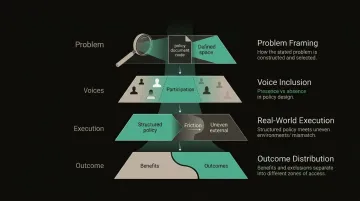
Applying the four-pillar framework to any document follows a systematic approach:
Step 1: Identify the stated problem — What problem does this policy claim to solve? Whose definition of the problem won out?
Step 2: Examine who drafted it and whose voices are absent — Who had a seat at the table during design? Whose perspectives were excluded or marginalised?
Step 3: Evaluate how implementation differs from stated intent — What happens when the policy meets real-world contexts? Who has resources to comply, and who faces barriers?
Step 4: Assess privilege — Who gains access and who is systematically excluded? Does the policy reproduce existing inequalities or challenge them?
Concrete Illustration: Insurance Policy Documents
Applying these steps to an insurance policy document reveals typical gaps consumers miss:
Coverage exclusions buried in fine print — 21% of EU consumers cite "unclear policy terms led to an unexpected denied claim" as a top reason for dissatisfaction with claims handling. Critical analysis asks: whose interests are served by burying exclusions in 32-page documents written in complex legal language?
Loyalty penalty pricing — Research from Denmark's competition authority found that customers with long tenure who do not actively search the market are in a "difficult negotiating position." Over time, loyal customers pay more than those who switch companies. The question worth asking: why do policies penalise loyalty rather than reward it?
Duplicate coverage across policies — A 2018 survey found that 33% of Danes do not review their insurance policies when moving in with a partner, leaving them vulnerable to paying twice for contents insurance but only able to claim once. Whose responsibility is it to prevent this — the consumer's, or the insurer's?
Language designed to obscure rather than clarify — A 2016 Danish consumer survey found that only 8% of Danes always read what they sign when accepting digital terms and conditions. Critical analysis asks: is this a failure of consumer diligence, or evidence that documents are intentionally designed to discourage scrutiny?
These are exactly the gaps that Inzure's AI-powered platform is built to surface. By scanning Danish insurance policy documents in 60 seconds, the platform identifies coverage exclusions, duplicate policies, and pricing inconsistencies that most consumers would never find on their own — putting the analysis that critical policy frameworks describe into everyday, practical use.
Frequently Asked Questions
What is a critical policy analysis?
Critical policy analysis is a research and evaluation approach that examines not just whether a policy achieves stated goals, but who shaped it, who benefits, and who is left out. It focuses on power dynamics, equity, and social justice rather than treating policies as neutral technical documents.
What are the five parts of policy analysis?
The five core stages are problem definition, identification of policy alternatives, evaluation of alternatives (including cost-benefit analysis), selection of the best option, and implementation and monitoring. Critical analysis adds interrogation of power and equity to each stage.
What are the 4 types of political analysis?
The four commonly referenced types are descriptive analysis (what is happening), explanatory analysis (why it happens), prescriptive analysis (what should be done), and evaluative analysis (how well a policy actually performed). Critical analysis cuts across all four types.
What is the difference between traditional and critical policy analysis?
Traditional analysis focuses on measuring whether a policy was implemented as designed and achieved stated objectives. Critical analysis interrogates the values, power structures, and equity implications embedded in the policy design itself, before evaluating whether implementation succeeded.
What are the key frameworks used in critical policy analysis?
Key frameworks each provide diagnostic tools for systematic analysis:
- Sabatier's Advocacy Coalition Framework — traces how competing coalitions shape policy over time
- Ball's policy cycle model — examines actors, trajectory, and contexts
- The four-pillar critical framework — covers policy influences, texts, implementation, and privileges
Why does the language used in a policy document matter?
Language choices signal underlying values and assumptions. Critical analysts treat rhetoric as evidence — the words a policy uses to define a problem and assign responsibility reveal whose interests the policy truly serves and what solutions are considered legitimate.