
Introduction
Policymakers, researchers, and informed decision-makers rarely have the luxury of working in a vacuum. The most effective policies are almost always shaped by looking at what works elsewhere, and why. Yet without a structured methodology, borrowed "best practices" often fail spectacularly in new environments.
Comparative policy analysis is the structured methodology that makes cross-context learning possible, underpinning everything from international health system reforms to sub-national regulatory experiments. When done rigorously, the results are measurable. The randomised evaluation of Mexico's PROGRESA conditional cash transfer program demonstrated a 60% increase in preventive care utilisation and a 23% reduction in child illness when evidence-informed policy transfer replaced ad hoc borrowing.
Applied properly, comparative methods prevent the misapplications and failed transplants that come from rushed policy copying.
This guide covers the core frameworks, real-world examples, and practical best practices that make comparative policy analysis work — from selecting comparable cases to translating findings into actionable recommendations.
Key Takeaways
- Comparative policy analysis systematically examines policies across settings to identify what works, why, and under what conditions
- Four types structure the field: cross-national, sub-national, cross-sector, and temporal comparison
- Effective analysis depends on strategic case selection, deep contextual understanding, and clear purpose
- Policy transfer — applying lessons from one setting to another — is the most actionable output
- Common pitfalls: naive transplantation, ignoring context, and convenience-driven case selection
What Is Comparative Policy Analysis?
Comparative policy analysis is a research and decision-making approach that systematically examines how policies are designed, implemented, and evaluated across at least two different settings—whether those settings are countries, sub-national governments, policy domains, or time periods. The goal is to generate insights that go beyond what any single case can reveal.
Core application areas include:
- Public health systems and healthcare financing
- Education system performance and reform
- Social welfare and pension programs
- Environmental regulation and carbon pricing
- Taxation policy and revenue structures
- Housing policy and affordability
- Labour markets and employment regulation
The method serves dual purposes: academic theory-building and practical policymaking. Scholars use it to test hypotheses about what conditions produce desired outcomes. Practitioners use it to identify alternatives to failing approaches or to understand why a policy succeeded elsewhere.
Two Broad Methodological Orientations
Comparative policy analysis traditionally divided into two camps:
Qualitative approaches examine 2-10 cases in depth, using process tracing and thick description to reveal the mechanisms behind outcomes. The trade-off is limited generalisability.
Quantitative approaches analyse dozens or hundreds of jurisdictions to identify broad statistical patterns across many cases. The trade-off is reduced contextual depth.
Neither approach alone resolves the depth-versus-breadth trade-off. That's why hybrid designs have become the dominant framework. Mixed-method nested analysis—starting with statistical patterns, identifying deviant cases, and using case study work to explain mechanisms—delivers the most robust causal inferences.
The Four Types of Comparative Policy Analysis
Selecting the right type of comparison is itself a critical analytical decision, not an afterthought. Scholars commonly distinguish four primary types derived from Lijphart's foundational work on comparative research design.
Cross-National Comparison
This is the most common type: comparing how different countries address the same policy problem—healthcare financing, carbon pricing, education standards. Its value lies in treating different national systems as natural experiments. When Sweden implements a carbon tax at 1,450 SEK per tonne while other countries choose lower rates, researchers can observe the differential impacts on emissions, economic growth, and political feasibility.
The challenge lies in controlling for vast contextual differences between countries. Political institutions, cultural attitudes toward redistribution, existing infrastructure, and historical legacies all shape outcomes. Without careful attention to these factors, cross-national comparison risks producing misleading lessons.
Sub-National Comparison
Comparing states, provinces, municipalities, or regions within the same country reduces many confounding variables present in cross-national work. When US states implement different minimum wage policies or Medicaid expansion decisions, researchers benefit from holding constant national-level factors like currency, constitutional framework, and federal law.
This is the empirical foundation behind the concept of "laboratories of democracy"—the idea that sub-national jurisdictions can experiment with policies, generating evidence about what works before (or instead of) national adoption. The contiguous county-pair methodology comparing counties on opposite sides of state borders exemplifies this approach's analytical power.
Cross-Sector Comparison
Policies across different domains often share structural logic — cross-sector comparison surfaces which design principles transfer and which depend on context. Examining performance-based contracting in defence versus healthcare, for example, reveals what succeeds because of sector-specific conditions versus what represents a universal management principle.
Key questions to ask before borrowing lessons across sectors:
- Does the regulatory environment share comparable enforcement mechanisms?
- Is the industry's concentration level (mature vs. fragmented) similar?
- Are the incentive structures for key actors roughly analogous?
A regulatory approach that succeeds in a concentrated, mature industry often fails in a fragmented, emerging one. Documenting these institutional features before drawing cross-sector conclusions is what separates insight from overreach.
Temporal Comparison
Comparing how the same system or country handles a policy problem across different time periods provides a longitudinal lens. Examining how a nation's education policy performs before and after reform, or across economic cycles, reveals how context and conditions shape effectiveness over time.
Temporal comparison is valuable for understanding path dependency — how early policy choices constrain later options — and for identifying the critical junctures when significant change becomes possible.
Most-Similar vs. Most-Different Systems Design
Beyond choosing what units to compare, analysts must choose between two fundamental case selection logics.
| Most-Similar Systems Design (MSSD) | Most-Different Systems Design (MDSD) | |
|---|---|---|
| Logic | Hold most variables constant; isolate one key difference | Choose highly divergent cases; find consistent relationships |
| Example | Two provinces with identical demographics but different healthcare financing models | Sweden, Singapore, and Canada all achieving universal coverage despite different political systems |
| Best suited for | Causal inference about specific policy features | Identifying universal relationships that transcend context |
| Risk | Assumes similarity on unmeasured variables | May conflate coincidence with causation across very different contexts |

The choice depends on research purpose. When you need to attribute an outcome to a specific policy design feature, MSSD is the right tool. When you want to establish that a relationship holds broadly — regardless of context — MDSD makes the more compelling case. Choosing the wrong design for your question weakens causal claims before the analysis even begins.
How Comparative Policy Analysis Works—Step by Step
In practice, the process is harder than the theory suggests. Common mistakes include selecting cases for convenience, skipping contextualisation, and drawing transferable conclusions without verifying contextual fit.
Step 1—Define the Objective
Clarify the specific policy question driving the comparison:
- Understanding why a policy succeeded in one context?
- Identifying alternatives to a failing approach?
- Testing a hypothesis about what conditions produce a desired outcome?
- Enabling policy transfer to a new setting?
Vague objectives produce unfocused case selection, inconsistent data collection, and ambiguous findings. Getting this right shapes every step that follows.
Step 2—Select Cases Strategically
Case selection is the mechanism through which extraneous variance is controlled. Cases should be chosen based on analytical logic (most-similar or most-different design), not convenience, familiarity, or language access.
Critical error to avoid: Selecting only successful cases—known as sampling on the dependent variable—skews findings and prevents valid causal inference. If you only study countries that achieved universal healthcare, you cannot identify what distinguishes success from failure. Include variation in outcomes.
Step 3—Gather Inputs
Comparative analysis requires multiple data types:
- Policy documents and legislative records
- Implementation reports and administrative data
- Outcome data (health statistics, educational performance, environmental metrics)
- Expert interviews and stakeholder perspectives
- Contextual background on political institutions, cultural values, and historical legacies
Qualitative and quantitative data must be combined to build a complete picture of how policies work in practice.
Step 4—Organise and Contextualise
Raw data must be structured around a common analytical framework so cases are genuinely comparable. This includes defining equivalent terms across different settings—avoiding the "concept travelling" problem where the same label means different things in different contexts.
"Universal healthcare" means single-payer in Canada, multi-payer social insurance in Germany, and tax-funded national health service in the UK. Without operational definitions, comparisons become meaningless.
Step 5—Apply the Comparative Framework
Directly compare cases against shared dimensions:
- Policy design and objectives
- Implementation mechanisms and administrative structures
- Contextual conditions (political, economic, cultural)
- Outcomes and performance metrics
Analytical tools at this stage:
- Qualitative Comparative Analysis (QCA) uses Boolean algebra to analyse complex configurations of variables, identifying which combinations of conditions produce outcomes
- Process tracing examines sequential mechanisms within cases to establish whether and how a potential cause influenced change
Step 6—Interpret and Act on Findings
The final step turns comparative insights into actionable guidance: recommending policy transfer, refining reform proposals, or pinpointing the contextual conditions another setting would need to replicate the same results.
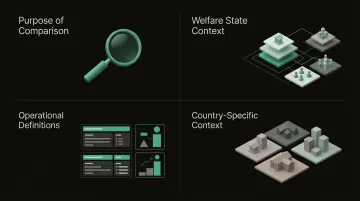
Marmor's four rules for cross-national comparison apply especially here:
- Reflect on the specific purpose of the comparison
- Understand the policy's location within the broader welfare state
- Use well-defined, operational definitions rather than misleading labels
- Understand the country-specific constellation of values and institutions
Comparative Policy Analysis in Action: Real-World Examples
Healthcare Financing Trade-Offs
Comparing single-payer systems (Canada, UK) against multi-payer systems (Germany, Netherlands, US) helps policymakers understand trade-offs between cost control, access, quality, and administrative burden.
Key findings from recent analysis:
| Country | Spending per Capita (USD) | % of GDP | Access & Outcomes Rank |
|---|---|---|---|
| United States | $14,885 | 17.2% | 10th (Last) |
| Germany | $9,365 | 12.3% | 9th |
| Netherlands | $8,436 | 10.0% | 2nd |
| Canada | $7,301 | 11.3% | 7th |
| United Kingdom | $6,747 | 11.1% | 3rd |
The Commonwealth Fund's Mirror, Mirror 2024 report shows the US spends 2.5 times the OECD average but ranks last in access and outcomes. High performers like the Netherlands and UK achieve better results with universal coverage that minimises out-of-pocket expenses and reduces administrative burden.
Context determines which model transfers successfully. Political institutions, cultural attitudes toward redistribution, and existing infrastructure all shape feasibility. Copying another country's healthcare model without these preconditions risks failure.
Carbon Pricing and Environmental Policy
Comparing carbon tax schemes across countries generates evidence about price levels, sector-specific impacts, and political feasibility. Key data points from cross-country comparisons include:
- Sweden's carbon tax (implemented 1991, now at 1,450 SEK per tonne) provides the longest-running effectiveness benchmark
- Canadian provincial comparisons refine these lessons with greater contextual control, holding federal policy constant while varying provincial approaches
- Price level, sector-specific impact, and political feasibility all emerge as distinct variables — each requiring separate analysis
Sub-National Policy Experimentation
US states routinely serve as natural comparison laboratories. Policy innovations in welfare reform, Medicaid expansion, and minimum wage legislation are tracked across states before federal adoption. Sub-national comparison increases analytical confidence by holding many macro-level variables constant—currency, constitutional framework, federal law—while isolating the effect of specific state policy choices.
This logic — controlling for shared variables while isolating a single policy difference — is what distinguishes rigorous comparative analysis from anecdote. It's why sub-national experiments often produce the clearest evidence for policy design.
Best Practices for Effective Comparative Policy Analysis
Be Explicit About Purpose Before Selecting Cases
The single most common mistake is choosing what to compare before clarifying why. Define whether the goal is theory-testing, identifying universals, explaining differences, or enabling policy transfer. Each purpose implies different design choices:
- Theory-testing requires variation in both independent and dependent variables
- Identifying universals suits most-different systems design
- Explaining differences suits most-similar systems design
- Enabling policy transfer requires deep contextual documentation of both source and target settings — including institutions, culture, and political conditions
Account for Context Rigorously and Resist Naive Transplantation
A policy that works in one setting does not automatically transfer to another. Effective comparative analysts document the institutional, cultural, and political conditions that produced success, then assess which conditions can be replicated.
Marmor's warning against both uncritical borrowing and the "fallacy of comparative difference" (rejecting all lessons because contexts differ) provides a useful guardrail. Use comparative analysis for "illumination without transplantation"—understanding causal mechanisms rather than copy-pasting policy designs.
Use Hybrid Methods and Iterate
Addressing context rigorously often means drawing on more than one method. The strongest comparative analyses combine large-N quantitative patterns with small-N qualitative depth — the former identifies broad relationships, the latter explains mechanisms and context.
One well-established approach for doing both is nested analysis:
- Start with statistical patterns across a large sample to identify general relationships
- Select deviant or outlier cases that the quantitative model doesn't explain
- Use in-depth case study work to uncover mechanisms, refine the theory, and revisit the broader dataset

How Inzure Can Help You Compare Your Insurance Policies
The core challenge in comparative policy analysis—making meaningful comparisons across complex, context-dependent options to find what actually works for a specific situation—is exactly the challenge Danish consumers face when comparing insurance policies.
Traditional approaches require hours of manual review across multiple insurers, policy documents filled with intentional complexity, and no independent benchmark for what a fair market price looks like. Without a structured comparison tool, most consumers end up overpaying — or carrying the wrong coverage entirely.
Inzure is Denmark's first AI-driven, independent insurance comparison platform — built to bring that same systematic logic to personal insurance decisions. Upload your existing policies and within 60 seconds, the platform identifies:
- Coverage gaps you didn't know existed
- Duplicate protections you're paying for twice
- Unfair price increases buried in renewal documents
- The real market rate for your specific situation
That's the kind of evidence-based comparison that was previously out of reach for most consumers.
Early users have achieved savings ranging from DKK 2,800 to DKK 48,000 annually by gaining transparency and market insight that traditional insurance companies have little incentive to share.
Frequently Asked Questions
What is comparative policy analysis?
Comparative policy analysis is the systematic study of how policies are designed, implemented, and evaluated across two or more settings—countries, regions, sectors, or time periods—to understand what works, why, and under what conditions.
What are some examples of comparative policy analysis?
Examples include comparing healthcare financing models across countries (single-payer vs. multi-payer systems), examining carbon pricing schemes in different national contexts (Sweden's high carbon tax vs. lower-rate alternatives), and studying how US states implement welfare or minimum wage policy differently.
What are the four types of comparative policy analysis?
The four main types are cross-national comparison (across countries), sub-national comparison (across states, provinces, or cities), cross-sector comparison (across policy domains or industries), and temporal comparison (examining the same system across different time periods).
What are the 4 P's of policy?
The 4 P's of policy typically refer to Policy (the rule or decision), Politics (the process and actors shaping it), Programs (how policy is implemented), and Performance (how outcomes are measured).
What is the difference between most similar and most different systems design?
Most-similar systems design selects cases that are alike on many variables but differ on one key feature, to isolate its effect. Most-different systems design selects highly divergent cases where finding the same relationship suggests a robust, universal pattern. The choice depends on analytical purpose and hypotheses being tested.
What is policy transfer in comparative policy analysis?
Policy transfer is the process of adapting lessons, designs, or instruments from one policy setting to another. It is often described as the most practical payoff of comparative analysis, but requires careful contextual assessment to avoid applying policies in unsuitable contexts.