Introduction
European travel insurance markets reveal a concerning pattern: in some cases, insurers return as little as 104 DKK in claims for every 746 DKK collected in premiums, according to EIOPA's 2019 regulatory review. Comprehensive travel insurance typically costs 5–10% of your total trip cost.
Many Danish travelers unknowingly inflate that expense by purchasing coverage they already hold through home insurance, credit cards, or public health benefits.
Most people buy travel insurance without checking what they already have. This guide covers:
- Which coverages you're likely duplicating across existing policies
- Which add-ons drain your budget without proportional value
- How to audit your existing protections before spending another krone
Key Takeaways
- Standard travel insurance costs 5–10% of trip cost, but redundant add-ons can push premiums well above that range
- Home insurance typically covers baggage abroad; some payment cards include trip delay and cancellation protection — check your existing policies before buying extra
- Cancel For Any Reason add-ons typically increase premiums by 40–50% while reimbursing only 50–75% of your costs
- One pre-purchase audit of existing coverage eliminates most overspend
- Check your home insurance (indboforsikring) first — it may already cover what a standalone travel policy would duplicate
How Travel Insurance Costs Build Up Over Time
Travel insurance expenses rarely appear as a single line item on your budget. Instead, they add up across multiple trips, especially when you auto-renew annual policies without reviewing whether your coverage still matches your actual travel patterns or existing protections.
The real cost driver is passive decision-making: accepting insurer defaults at checkout, bundling add-ons "just to be safe," or upgrading to premium tiers without examining whether the extra coverage addresses genuine risks in your itinerary.
Hidden duplication is often where the real money leaks. Common overlaps include:
- Baggage cover — your home contents policy (indboforsikring) may already protect personal belongings abroad
- Medical coverage — your existing health insurance may extend internationally, and your Danish EU health card covers public healthcare across the EU
EIOPA's regulatory review found that many travel insurance sales don't assess whether customers already hold overlapping coverage, leaving duplicate protection undetected until claim time. By then, you've already paid twice for the same benefit.
Key Cost Drivers That Inflate Your Travel Insurance Premium
Four variables primarily determine what you pay: total trip cost, your age, trip length, and coverage type. The first three are fixed once you've booked. Coverage choices are the only factor you fully control.
How Add-Ons Compound Quickly
Each upgrade adds percentage points to your base premium. Cancel For Any Reason (CFAR) alone adds 40–50%. Adventure sports riders, high-limit medical coverage, and business equipment protection stack on top of each other. When selected by default or without scrutiny, these additions can double your cost.
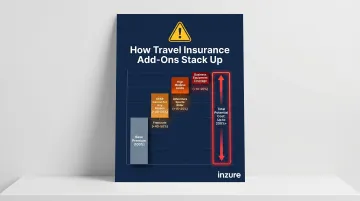
Premium-tier plans often advertise medical coverage limits 10–20 times higher than standard plans, sometimes reaching millions of kroner. For a standard holiday, hitting that ceiling is extremely unlikely — making the upgrade rarely worth the extra cost.
Duration Mismatches Drive Waste
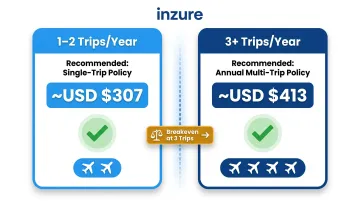
The type of policy you choose matters as much as the coverage inside it. Travelers taking one or two trips per year who purchase annual multi-trip policies overpay significantly. Annual plans become cost-effective around three or more trips; below that threshold, single-trip policies deliver better value. Similarly, buying comprehensive international-grade coverage for a short domestic trip wastes money on protections you don't need.
Cost-Reduction Strategies for Travel Insurance
Effective cost reduction happens at three levels: what you choose upfront, how you manage existing policies, and what coverage you already carry. Each layer compounds the savings from the others.
Strategies That Reduce Costs by Changing Coverage Decisions
Skip Cancel For Any Reason unless genuinely necessary. CFAR increases premiums by 40–50% and reimburses only 50–75% of non-refundable costs. Standard trip cancellation already covers illness, death, natural disasters, and airline bankruptcy—scenarios that account for the vast majority of legitimate cancellations. CFAR makes sense only if you have a specific, high-probability reason to cancel for a discretionary cause.
Avoid flight insurance (crash coverage). This functions as a narrow life insurance policy covering only in-flight deaths. ICAO's 2025 Safety Report recorded 65 fatalities per billion passengers on scheduled commercial flights in 2024—a rate of 2.56 accidents per million departures. With commercial aviation this safe, flight-crash insurance represents poor value for money.
Match policy type to travel frequency:
- 1-2 trips per year: Single-trip policies are almost always cheaper
- 3+ trips per year: Annual multi-trip policies break even and save money beyond this threshold
- Average annual plan costs around 2.891 DKK versus 2.149 DKK for single-trip coverage; the annual option only makes financial sense when trip frequency justifies the fixed cost
Avoid excessive medical coverage ceilings unless traveling to high-cost destinations. For standard European trips where healthcare infrastructure is accessible and quality is high, standard medical limits are almost always sufficient. Reserve ultra-high ceilings for destinations like the USA or remote areas requiring expensive evacuation.
Strategies That Reduce Costs by Changing How Travel Insurance Is Managed
Audit home/contents insurance before purchasing baggage cover. Many Danish home insurance policies already cover personal belongings while traveling, including theft abroad. Check your policy documents for:
- Geographic scope (does it extend outside Denmark?)
- Deductible levels
- Per-item limits for electronics or valuables
This single check can eliminate a common add-on entirely.
Review credit card travel benefits before buying standalone coverage. Many premium Danish credit cards include trip cancellation, travel delay, and accident coverage. For example, Jyske Bank's Platinum card offers up to 60,000 DKK per person for trip cancellation and 7,500 DKK for flight delays over four hours.
These benefits often have lower limits and specific exclusions (such as requiring you to pay for the trip with the card), so comparison is essential. Map what's already covered and purchase only the gap, not a duplicate policy.
Cross-reference all your policies before buying new coverage. If auditing home insurance and credit card benefits manually feels like a lot to track, Inzure can upload and compare your existing policies in 60 seconds. The platform identifies duplicated coverages across home, health, and travel policies—so you know exactly what you're double-paying for before renewing.
Review and consciously opt out of auto-renewals. Travelers who auto-renew travel policies without reassessing often carry coverages that no longer match their current travel behavior, health status, or itinerary. An annual review is the minimum standard for cost control.
Strategies That Reduce Costs by Changing the Context Around Travel Insurance
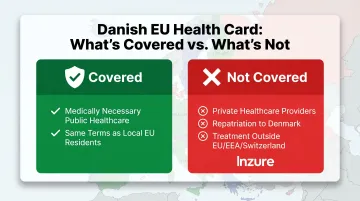
Verify whether existing health insurance covers medical emergencies abroad. Within the EU, your Danish EU health card provides access to medically necessary public healthcare on the same terms as local residents. However, it doesn't cover:
- Private healthcare providers
- Repatriation to Denmark
- Treatment outside the EU/EEA/Switzerland
Even where international health coverage exists, high deductibles may still make supplemental coverage worthwhile in high-cost destinations.
Consider higher deductibles if you're a low-risk traveler. Choosing a policy with a higher excess in exchange for a lower premium is rational if you:
- Have a strong safety record
- Travel to low-risk destinations
- Have the financial buffer to absorb a small claim
This is a contextual trade-off, not a universal recommendation.
Leverage group and family policies when traveling with companions. Danish insurers often structure pricing to cover entire households rather than individual travelers, offering better per-person rates for joint or family policies compared to purchasing separate coverage. Starting prices can be as low as 596 DKK per year when multiple people are covered.
Remove destination-irrelevant coverage. For domestic or short-haul European travel where:
- Evacuation risk is low
- Medical infrastructure is accessible
- Your health insurance already applies
Stripping out evacuation or emergency repatriation add-ons may be justified. This approach is appropriate only for specific traveler profiles and itineraries—do not remove essential coverage for high-risk destinations.
Conclusion
Most travelers overpay for travel insurance not because it's inherently expensive, but because they buy without knowing what coverage they already have — and choose without knowing what they actually need.
Effective cost reduction is a one-time audit followed by an ongoing habit: check existing coverage before buying, match policy to trip profile, and review annually. The travelers who pay less aren't skipping coverage — they're buying only what their existing policies don't already provide. That starts with knowing what you have. Tools like Inzure can analyze your current policies in 60 seconds, showing exactly where you're covered and where you're not before you spend a kroner more.
Frequently Asked Questions
What travel insurance coverages can I usually skip if I already have home insurance?
Many Danish home/contents insurance policies cover personal belongings abroad, including theft while traveling. Check your policy's geographic scope and deductible before paying for separate baggage coverage—you may already be protected.
Is Cancel For Any Reason (CFAR) coverage worth the extra cost?
CFAR adds 40–50% to your premium and reimburses only 50–75% of costs. It makes sense only if you genuinely expect to cancel for a reason standard policies don't cover. For most travelers, standard trip cancellation coverage is sufficient.
Does my credit card already provide travel insurance coverage?
Many premium cards include trip cancellation, delay, and accident coverage, such as Jyske Bank's cards offering up to 60,000 DKK per person. These benefits have limits and exclusions—typically requiring that you paid for the trip with the card—so check what's covered before buying a separate policy.
How much should travel insurance typically cost as a percentage of my trip?
As a general benchmark, comprehensive travel insurance typically runs 4–10% of total trip cost, averaging around 6% internationally. Consistently paying above this range suggests your coverage levels, add-ons, or policy type may need review.
What's the difference between single-trip and annual travel insurance, and which saves more money?
Single-trip policies are almost always cheaper for 1-2 trips per year. Annual multi-trip policies break even around three or more trips; below that threshold, you overpay for coverage you don't fully use.
Can I remove specific coverages from a travel insurance policy, or must I buy a full package?
Most insurers sell bundled plans, so removing individual elements isn't straightforward. The practical alternative is choosing a basic plan over comprehensive and skipping upgrades—CFAR, high medical limits, and adventure sports riders—which achieves much the same result at lower cost.