
This article covers the concrete warning signs of overpayment, a step-by-step method to audit your own policies, how to interpret what you find, and what to do next. The signs of overpaying aren't obvious — you won't get a letter saying "we're overcharging you." You need a framework to diagnose it yourself.
Key Takeaways
- No policy review in the past year? You're almost certainly overpaying
- The same coverage can cost nearly 40% more at one Danish insurer versus another
- Loyal customers pay approximately DKK 1,200 more per year after a decade with the same insurer
- Auditing your own policy takes no expertise — check your deductibles, spot duplicate coverage, and compare premiums side by side
- Switching or renegotiating is simpler than most people expect, with annual savings that can exceed DKK 5,000
The Warning Signs You're Paying Too Much for Insurance
Overpaying rarely announces itself. Instead, it shows up as a pattern of small, easy-to-miss signals. Here's a checklist you can run through right now.
You Haven't Changed Insurers in Several Years
Danish insurers routinely offer their best rates to new customers while gradually raising prices for existing ones. According to research by the Danish Competition Council, a customer who has been with the same insurer for 10 years pays approximately DKK 100 more per month than a new customer for equivalent coverage.
That's DKK 1,200 extra per year — simply for staying put.
Most insurers offer a loyalty discount of a few percentage points — but this doesn't offset cumulative rate increases. Check your annual renewal documents for a pattern: if your premium has climbed steadily while your coverage remained unchanged, you're likely experiencing this "loyalty penalty."
Your Premium Went Up Without Any Obvious Reason
Insurance companies adjust rates based on market-wide factors like claims inflation and regional risk — factors that have nothing to do with your personal history. A clean record is no guarantee of a stable or fair rate.
Between 2023 and 2025, prices rose by up to 37% for certain consumer profiles across Danish insurers. Total prices increased by over 21% at Topdanmark and 17% at TJM across four tested insurance types. Check your year-over-year premium history: a steady upward trend without corresponding changes in your circumstances means you're losing money to market inertia, not increased risk.
You Have Multiple Policies From Different Providers
If you've accumulated policies over time — home, travel, accident, liability — from different providers, you likely have duplicate coverage. Common overlaps include:
- Personal accident cover in both travel and accident policies
- Legal aid included in home and standalone policies
- Bicycle theft covered in both home contents and separate bicycle insurance
- Travel insurance from credit cards, health cards, and standalone policies
Gaps are just as costly. Some policy combinations leave critical risks unprotected — you could find yourself uninsured for a burglary or injury abroad, even while paying premiums across four separate policies.
You've Never Compared Quotes
The same coverage for the same person can differ significantly in price between insurers. Each company uses its own risk models, and some specialize in certain customer profiles.
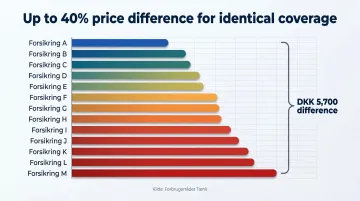
Testing by Forbrugerrådet Tænk across 13 of Denmark's largest insurers found that the price difference between the cheapest and most expensive provider was DKK 5,700 — nearly a 40% spread. In one case, the most expensive company charged more than double the cheapest for comparable coverage. Without comparing, you have no way to know where your premium falls on that spectrum.
How to Audit Your Own Insurance Coverage
A proper insurance audit comes down to three checks: are you paying the market rate, do you have overlapping coverage, and do you have gaps? No expertise needed — just a methodical approach.
You can do this manually by following these steps, or use a platform like Inzure, which performs this analysis across all Danish insurers in 60 seconds.
Step 1: Gather All Your Policy Documents
Collect every active insurance policy you hold:
- Home contents (indboforsikring)
- Home building (husforsikring)
- Travel (rejseforsikring)
- Accident (ulykkesforsikring)
- Liability (ansvarsforsikring)
- Legal aid (retshjælp)
- Bicycle theft (cykeltyveri)
For each policy, list:
- Annual premium
- Deductible (selvrisiko)
- Main coverage inclusions and exclusions
- Policy renewal date
Step 2: Check Your Deductible Against Your Savings
The deductible trade-off is straightforward: a low deductible means higher premiums. Most people rarely claim.
Common deductible levels in Danish home contents insurance range from DKK 1,000 to DKK 3,000. Increasing from DKK 0 to DKK 3,000 reduces your annual premium by an average of 24.4%. Further increases to DKK 5,000 yield only an additional 9.5% reduction — diminishing returns.
Ask yourself: what can you afford to cover out of pocket? If you have savings to absorb DKK 3,000, choose the higher deductible and keep the premium difference. If covering everyday replacements without upfront costs matters more, stay with a lower deductible.
One caution: filing too many small claims can prompt your insurer to raise your premium or cancel your policy entirely.
Step 3: Identify Overlapping Coverage
Check for these common overlap scenarios:
Travel insurance duplicates:
- Credit card travel coverage (especially MasterCard)
- EU health coverage via the Blue Card
- Travel protection bundled with home contents insurance
- Standalone travel policies
Personal accident coverage:
- Included in both accident insurance and travel policies
- Duplicate leisure-time accident protection
Bicycle theft protection:
- Covered in home contents insurance
- Purchased as standalone bicycle insurance
Legal aid coverage:
- Included in home contents policies
- Purchased as separate legal aid insurance
Any overlap you find is a direct cut to your premiums — cancel the duplicate and keep the stronger policy.
Step 4: Compare Your Premium to the Market Rate
Price comparisons only mean something when you're comparing like for like. Get at least three quotes and hold these variables constant:
- Same deductible
- Same coverage limits
- Same add-ons (legal aid, bicycle theft, etc.)
- Same family structure and coverage scope
Forbrugerrådet Tænk's testing of 13 Danish insurers found that in 8 out of 15 cases, the same company ranked among the cheapest for one product and among the most expensive for another. There's no single "best" insurer — only the right one for your specific profile.
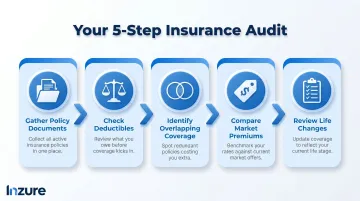
Step 5: Review Your Life Changes Since You Last Updated Your Policy
These life events should trigger a policy review:
- Moving house
- Getting married or divorced
- Having children
- Paying off a car loan
- Changing jobs
- Buying new valuables
Each of these shifts what coverage you need, and policies don't update automatically. Many customers discover their partner isn't listed on shared policies, or that they're being charged for a newborn despite the policy stating children are free until age two.
How to Interpret What You Find
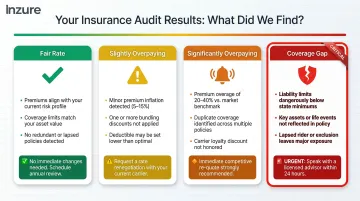
Once you've done the audit, your results will fall into one of four categories — each calling for a different action.
You're Paying a Fair Rate With the Right Coverage
Normal looks like this: your premium is within 10-15% of the cheapest comparable quote, you have no major overlaps, and your deductibles are appropriate for your savings.
Next step: Set a calendar reminder to recheck annually at renewal time. The Danish insurance market changes, and a fair rate today may not be fair in 12 months.
You're Slightly Overpaying or Have Minor Coverage Issues
Your premium is 15-30% above market, or you've identified one or two overlapping add-ons.
Next steps:
- Contact your insurer about a loyalty review
- Remove duplicate add-ons
- Get 2-3 fresh quotes at next renewal
- Consider whether switching providers makes sense
You're Significantly Overpaying or Have Structural Problems
Your premium is well above market rate, you're paying for duplicate coverage across multiple policies, or you have identifiable gaps that leave you exposed.
Next steps:
- Switch providers immediately
- Consolidate policies where it makes sense
- Ensure the new setup fully covers what the old one did before cancelling anything
- Document all coverage details during the transition
The Most Dangerous Finding — A Coverage Gap
The most serious audit finding isn't overpaying — it's being underinsured. A proper audit's goal is to ensure what you're paying for actually protects you, not just to cut costs.
A cheaper policy that leaves a major risk uncovered is a liability, not a saving. Common gaps to watch for:
- Missing bicycle theft coverage (Cykeltyveri)
- Inadequate sum-insured for valuables
- Partners or family members excluded from household coverage
Common Mistakes When Reviewing Your Insurance
Several common errors lead people to wrong conclusions : cutting coverage they actually need, or missing savings that were available all along.
Comparing Only the Premium, Not the Coverage
The trap: choosing the cheapest quote without checking that it includes the same deductible, limits, and exclusions as your existing policy.
Two policies that look identical in price may cover very different things. One might have a DKK 3,000 deductible while the other has DKK 1,000. One might exclude bicycle theft or legal aid. Always compare:
- Deductible amounts
- Coverage limits (sum insured)
- Exclusions and conditions
- Family member coverage
- Add-on protections
Cancelling a Policy Before the New One Is Confirmed
Any gap between cancelling an old policy and a new one taking effect leaves you uninsured. The correct sequence:
- Get quotes and select new coverage
- Purchase new policy
- Confirm new coverage is active and effective date is set
- Cancel old policy with appropriate notice
- Verify cancellation confirmation
Even a single day without coverage can mean an uncovered claim — so the sequence matters.
Assuming the Loyalty Discount Makes Switching Not Worth It
Once you've safely switched policies, a subtler problem remains: loyalty pricing. Insurers often frame discounts like "10% off as a valued customer" as meaningful perks. But if the base rate has risen 20–30% over several years, that discount applies to an already inflated number.
The real comparison is against the market rate, not against last year's bill. One consumer using Forbrugerrådet Tænk's template saved DKK 3,500 annually by challenging their insurer on this exact point.
What to Do If You're Overpaying
Once you've confirmed you're overpaying, there are three main levers: negotiate, switch, or optimize. The right move depends on how significant the gap is.
Negotiate First, Switch if Necessary
Calling your insurer and referencing a lower competitor quote often results in a price match or reduction. Insurers would rather reduce the price than lose the customer.
Frame the conversation this way:
- Reference your tenure as a loyal customer
- Mention the Competition Council's findings about loyalty penalties
- Present specific competitor quotes with identical coverage
- Ask directly: "Can you match this rate?"
Have ready: competitor quotes, your policy details, and your account history. If they refuse to adjust, switching becomes the clear choice.
Switch and Consolidate Where It Makes Sense
Combining multiple policies with one insurer — such as home contents and travel — can unlock discounts. But bundling isn't always cheaper.
Forbrugerrådet Tænk's 2025 testing concluded that bundle discounts "most often do not pay off" for consumers. You can often find better coverage by purchasing policies individually or choosing a company that doesn't use bundle discounts.
If you have home contents and building insurance with the same insurer, you typically pay only one deductible for a single event (like a burglary), versus two deductibles if policies are held at different companies.
⚠ Warning: Bundled policies may use "total risk assessment," where a claim on one policy can trigger a premium increase on a different policy.
Use Continuous Monitoring to Stay on the Right Side of the Market
Being overcharged once is manageable. Without ongoing monitoring, though, rates can drift upward every renewal cycle — quietly, and without any notification from your insurer.
Inzure's continuous market monitoring watches prices across all Danish insurers and flags when better options appear. The system notifies you only when there's actionable information: a significant price-saving switch, a coverage upgrade at the same price, or an unjustified premium increase from your current insurer. No action is taken without your approval.
Frequently Asked Questions
How do I know if I am paying too much for insurance?
Three clear signals: your premium has increased without any change in your circumstances, you haven't compared quotes in years, or you've found duplicate coverage across policies. Running a market comparison is the most direct way to check.
How do I know if I have overlapping or duplicate coverage?
Review your policies side by side and check whether the same risk is covered under more than one policy — for example, personal liability appearing in both your home contents policy and a separate accident policy. Duplicate coverage means you're paying twice for the same protection. Cancelling the redundant policy is usually straightforward and can generate immediate savings.
What should I do if my insurance company overcharged me?
First, verify the overcharge by comparing quotes from at least three insurers. Then contact your insurer directly to request a review or price match. If they won't budge, switching to a better-priced provider with equivalent coverage is your clearest option.
Is there a rule of thumb for when to drop certain insurance coverage?
If the annual premium for specific coverage exceeds roughly 10% of what you'd receive from a claim payout, it may no longer be cost-effective. Factor in whether you could cover the loss yourself and how likely you are to actually need the coverage.
What is the 80% rule in insurance?
Many home contents insurers require that your property be insured for at least its full replacement value. If you're underinsured, the insurer may pay only a proportional share of any claim — even for partial damage — leaving you responsible for the shortfall. This is sometimes called the proportionality rule, and it's a common reason policyholders receive less than they expected after a claim.