Introduction
Most people haven't read their insurance policy in full — and insurance companies count on that. Policies are written in dense legal language, structured to obscure what's actually covered, and quietly updated at renewal time. The result: millions of households pay for coverage they don't need, miss gaps they don't know exist, and overpay by hundreds of kroner every year without realizing it.
AI is changing what's possible here. Policy review tools now read and analyze insurance documents in seconds, identify coverage gaps, flag duplicate policies, and compare your current terms against better alternatives — work that once took hours of careful reading and provider calls.
This guide covers the top AI-powered policy review tools available in 2026, what features to look for, and how to find the right fit — whether you're a Danish household optimizing home and travel insurance, or simply trying to understand what you're actually paying for.
Key Takeaways
- AI compliance tools automate document analysis, risk assessment, and audit preparation using machine learning and NLP
- Top platforms include Drata, Vanta, Compliance.ai (Archer), Streamline AI, and Inzure, each built for different use cases — from enterprise GRC to consumer insurance review
- Must-have capabilities include automated policy analysis, continuous regulatory monitoring, semantic search, and GDPR-compliant data handling
- Choose based on your use case (enterprise GRC vs. legal operations vs. consumer insurance review) and integration needs
- AI handles the heavy lifting — but human experts still need to own final decisions and accountability
What Are AI Compliance & Policy Review Tools?
AI policy review tools are software platforms that use machine learning and natural language processing to read, analyze, and compare policy documents automatically. For individual consumers, this means uploading an insurance policy and getting a plain-language breakdown of what you're covered for, what's missing, and whether you're overpaying — in seconds rather than hours.
These tools fall into two broad categories:
Enterprise compliance platforms serve legal and risk teams inside large organizations, automating regulatory monitoring and audit documentation across frameworks like GDPR and ISO 27001.
Consumer-facing policy analysis tools are built for individuals. They scan your existing policy documents, flag coverage gaps or duplicate coverage, and compare your current plan against available market options — without requiring you to read dozens of pages of fine print.
Key capabilities you'll find in consumer-oriented tools include:
- Uploading PDFs or photos of existing policy documents for instant analysis
- Identifying missing coverage areas and overlapping policies
- Comparing your current premiums against market rates from multiple providers
- Answering specific questions about what your policy does and doesn't cover
- Alerting you when better options become available

The AI governance and policy analysis market is projected to reach $3.59 billion by 2033, growing at 36.0% annually — a pace driven largely by consumers and businesses demanding clearer, faster answers from documents that were never designed to be understood easily.
Top AI Compliance & Policy Review Tools for 2026
These tools were selected based on four criteria:
- AI capability depth and auditability
- Verified user ratings from G2 and Capterra
- Use case breadth across compliance workflows
- How well each addresses both compliance automation and policy document review
Drata
Drata is an AI-native continuous trust and GRC platform serving startups through enterprise organizations. It's known for embedding AI across compliance workflows including audit prep, control monitoring, and vendor risk management.
Its Responsible AI approach stands out: all AI actions are logged and auditable, with no output published without human oversight. The platform includes purpose-built agents like the VRM Agent for vendor risk, plus no-code custom control tests that let teams automate repetitive compliance tasks without sacrificing accountability.
| Criteria | Details |
|---|---|
| Best For | Enterprise and mid-market companies seeking automated GRC, audit readiness, and cross-departmental compliance workflows |
| Key AI Features | Test failure insights, VRM Agent for vendor risk, Trust Library search, automated control testing, AI-powered SOC 2 summaries |
| Ratings | G2: 4.7/5 (1,145 reviews); Capterra: 4.8/5 (5 reviews) |
Vanta
Vanta is a compliance automation platform focused on helping organizations pass audits faster and maintain continuous compliance. It's particularly popular with startups, scale-ups, and mid-market companies navigating their first audit.
Vanta's AI differentiators include automatic parsing of security questionnaires and SOC 2 reports, adaptive audit scoping by framework, and evidence-to-control mapping that cuts manual prep time significantly. The Vanta AI Agent automates evidence collection and helps teams identify which tests overlap across frameworks to reduce duplication.
| Criteria | Details |
|---|---|
| Best For | Startups and mid-market companies seeking to speed up their first audit and simplify ongoing compliance as they scale |
| Key AI Features | Vanta AI Agent, adaptive framework scoping, automated evidence collection, document parsing, policy-to-control mapping |
| Ratings | G2: 4.6/5 (2,351 reviews); Capterra: 4.2/5 (33 reviews) |
Compliance.ai (Archer)
Compliance.ai—now part of Archer—is a regulatory change management platform that uses machine learning to continuously monitor regulatory updates, parse legal documents, and map changes to internal policies and controls. It's especially valuable for highly regulated industries like financial services and insurance.
The platform automatically compares different versions of regulatory documents and equivalent rules across jurisdictions, giving compliance teams early warning of upcoming obligations. It uses a patented Expert-in-the-Loop (EITL) machine learning approach that maps regulatory requirements to internal controls across 99 jurisdictions.
| Criteria | Details |
|---|---|
| Best For | Financial services, insurance, fintech, and energy companies managing complex, multi-jurisdictional regulatory obligations |
| Key AI Features | Regulatory monitoring, searchable regulatory library, automated change summaries linked to internal controls, EITL machine learning |
| Ratings | Limited public reviews post-Archer acquisition; G2: 4.0/5 (20 reviews) |
Streamline AI
Streamline AI is a legal operations platform built specifically for in-house legal teams. It combines AI-powered intake, automated workflow routing, and a semantic policy search engine that allows teams to find policy answers using natural language queries.
The practical differentiator is its semantic policy search—AI understands context and intent behind queries rather than relying on keyword matching. In-house legal teams using the platform report 40-50% reduction in request turnaround times, a result that reflects how much time keyword-based search was previously wasting. The company raised $8.6 million in Series A funding in 2025.
| Criteria | Details |
|---|---|
| Best For | In-house legal teams at mid-to-large enterprises managing high volumes of policy inquiries, contract reviews, and compliance documentation |
| Key AI Features | AI-powered intake and triage, semantic policy search, automated workflow management, real-time analytics |
| Ratings | G2: 4.8/5 (28 reviews); Capterra: 0.0 (0 reviews) |
Inzure
Inzure is Denmark's first AI-driven independent insurance policy review platform—designed for consumers and families who want to understand, compare, and optimize their insurance policies without relying on insurers. It offers full GDPR-compliant EU data storage.
Unlike the enterprise tools above, Inzure focuses entirely on individual consumers. The platform reads and analyzes insurance policy documents across all Danish insurers in 60 seconds, automatically identifying coverage gaps, duplicate policies, and unfair price increases. Users upload policies as PDFs or photos, receive an immediate analysis, and decide whether to switch—with no obligation or hidden fees.
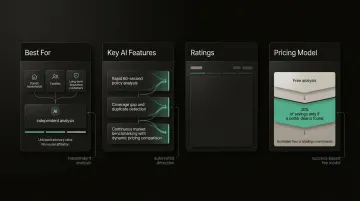
| Criteria | Details |
|---|---|
| Best For | Danish consumers, families, and loyal insurance customers who want an independent, AI-powered analysis of their current policies without obligation to switch |
| Key AI Features | 60-second policy analysis, gap and duplicate detection, market price benchmarking, continuous monitoring for price increases |
| Ratings | Not publicly listed |
| Pricing | Free analysis; 20% of savings only if a better deal is found—no hidden fees, no binding commitments |
Key Capabilities to Look for in an AI Policy Review Tool
Automated Document Analysis and Semantic Search
The tool should understand the meaning and context of policy language, not just search for keywords. Traditional keyword searches (like BM25) successfully find only 20-24% of relevant documents, while semantic search implementations exceed 90% recall by recognizing that phrases like "failure to perform" and "breach of contract" address the same concept.
Look for platforms that:
- Use NLP models to extract meaning from complex policy language
- Support natural language queries so teams can ask questions conversationally
- Deliver relevant results even when query phrasing differs from policy terminology
Continuous Monitoring and Regulatory Change Tracking
A strong tool alerts you when regulations, policy terms, or market conditions change—preventing compliance gaps from developing silently. Thomson Reuters made over 155 million global trade content updates in 2025, reflecting the massive scale of regulatory change organizations must track.
Effective monitoring includes:
- Real-time alerts for regulatory changes affecting your industry
- Automatic mapping of new requirements to existing controls
- Proactive scanning to surface emerging obligations before they become deadlines
Data Security and Privacy Standards
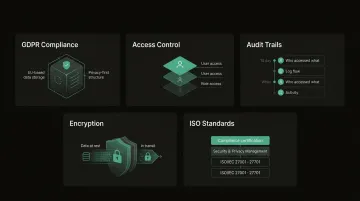
Any tool handling sensitive documents—contracts, insurance policies, compliance records—must have verifiable data protection practices. For EU-based deployments especially, the bar is high. Confirm that platforms meet:
- GDPR compliance with EU-based data storage
- Role-based access controls limiting who can view sensitive information
- Clear audit trails showing who accessed what and when
- Encryption standards for data at rest and in transit
- ISO/IEC 27001 and 27701 alignment for information security and privacy information management
How We Chose the Best AI Compliance & Policy Review Tools
Tools were assessed on four criteria:
- Depth of AI capability — does the tool understand policy context, or just scan for keywords?
- Verified user reviews — ratings from G2 and Capterra reflecting real-world experience
- Range of use cases — whether the tool works for individual consumers, families, or professional teams
- Responsible AI design — transparency and human oversight so you can trust what the AI flags
Choosing based on feature lists alone is a trap. What matters is whether the AI can explain its findings clearly — not just flag something, but show you why it matters and what to do about it.
The right tool depends on your situation. Someone reviewing a home insurance policy has different needs than a legal team — so context shapes what "best" actually means.
Conclusion
Regulatory obligations have grown too complex and too numerous for manual review to keep pace. The right tool depends entirely on where you sit in that landscape.
Enterprise GRC platforms like Drata and Vanta serve compliance teams managing frameworks like SOC 2 and ISO 27001. Streamline AI suits legal professionals handling high inquiry volumes. For individual consumers — particularly those trying to make sense of dense insurance documents — the need is less about regulatory frameworks and more about plain-language clarity. That's where tools like Inzure fit: AI-powered policy analysis that tells you what you're actually covered for, in 60 seconds.
Danish consumers can upload their policies to Inzure to find out what their insurance actually covers and whether they're overpaying. The analysis is free, and Inzure only takes a cut if it finds a better deal and you choose to switch.
Frequently Asked Questions
Which AI is best for policy analysis?
It depends on the type of policy. For enterprise regulatory and compliance documents, tools like Drata, Vanta, and Compliance.ai lead the market. For insurance policy analysis at the consumer level, Inzure provides AI-driven review in 60 seconds across all Danish insurers.
What is the 30% rule in AI?
The "30% rule" is a business heuristic suggesting AI should handle roughly 70% of repetitive tasks while humans retain 30% for oversight, ethical reasoning, and contextual judgment. It's not a formal ISO or NIST standard — more a practical rule of thumb for dividing work between humans and AI systems.
What is the difference between AI compliance tools and AI governance platforms?
AI compliance tools help organizations meet external regulations and manage GRC workflows. Governance platforms go further — they oversee how AI systems are deployed, monitored, and audited for fairness and accountability.
Can AI tools fully replace compliance officers?
No. AI handles repetitive tasks like document review, audit prep, and regulatory monitoring, but human judgment and contextual knowledge remain essential. The EU AI Act legally requires human oversight for high-risk systems, making AI a productivity tool for compliance teams rather than a replacement.
How do AI policy review tools protect sensitive data?
Key protections to look for include:
- EU-based data storage with GDPR compliance
- End-to-end encryption and role-based access controls
- Clear audit trails for accountability
Inzure, for example, stores all data in the EU under GDPR standards.
What should I look for when choosing an AI compliance tool in 2026?
Prioritize fit for your use case (GRC vs. legal policy lookup vs. insurance review), AI transparency and auditability, integration with existing workflows, data security standards, and whether the pricing model scales with your needs.