The problem stems from how families build their insurance portfolios. Home contents, accident cover, travel insurance, health policies, liability protection — each purchased at different times, from different providers, often in response to specific life events rather than comprehensive planning. Over time, this patchwork approach creates blind spots. Premiums creep upward year after year, loyalty goes unrewarded, and policy language remains deliberately opaque.
In 2024, over 490,000 Danish customers switched insurance providers — a record that reflects growing frustration with this status quo. Yet 75% of Danish insurance customers still never negotiate their premiums, leaving money on the table year after year.
This guide explains what family policy analysis is, what comprehensive family coverage should include, how to identify dangerous gaps yourself, and how to take action that protects your household without overpaying.
TLDR
- Family policy analysis reviews all household insurance to find gaps, duplicates, and overcharging
- Most families discover missing coverage for children's accidents, underinsured contents, or duplicate travel policies
- Loyal customers pay approximately 240 kr more annually on contents insurance alone compared to new customers
- Annual reviews at every major life event prevent coverage gaps and loyalty penalties
- AI-powered tools can analyze policies across all Danish insurers in 60 seconds
What Is Family Policy Analysis?
A family policy analysis is the systematic review of every insurance policy protecting your household — examining coverage scope, exclusions, premium levels, and how policies interact — to ensure you're neither underprotected nor overpaying.
Most families assume their coverage is fine until something goes wrong. In reality, insurers raise premiums without announcement, and policies bought years ago rarely reflect your household's current risks — new children, a home purchase, an income change. Danish data shows customers loyal to one insurer for 10+ years pay an average of 240 kr. more per year on contents insurance than new customers receive for identical coverage.
That gap doesn't close on its own.
Two Types of Coverage Gaps
Some failures are obvious: no accident insurance for your children, missing liability coverage entirely. These are explicit gaps — protections you simply don't have.
Far more dangerous are implicit gaps buried in policy fine print. These include:
- Waiting periods that delay claims for months after purchase
- Exclusions for pre-existing conditions that render entire sections of coverage worthless
- Payout caps that seem adequate until you calculate replacement costs
- Activity restrictions that void coverage during sports, travel, or even routine family activities
Both types expose your family to financial risk, but implicit gaps are harder to spot without reading every page of every policy document.
Key Areas Covered by a Comprehensive Family Insurance Policy
Children's Accident and Health Coverage
Many families assume school systems or public healthcare cover more than they actually do. Denmark's public health system provides free treatment but does not provide lump-sum compensation for permanent disability or injury — the specific protection accident insurance delivers.
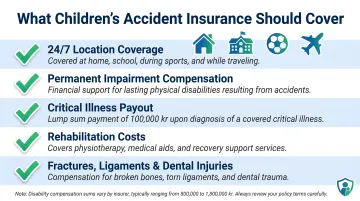
Comprehensive children's accident insurance should include:
- 24/7 coverage regardless of location (home, school, sports, travel)
- Compensation for permanent impairment from accidents
- Critical illness payouts (typically 100,000 kr as one-time sum)
- Rehabilitation costs including physical therapy
- Bone fractures, torn ligaments, and dental injuries
Forbrugerrådet Tænk tested 13 Danish insurers on accident coverage, evaluating disability sums ranging from 800,000 kr to 1,800,000 kr. Their testing revealed significant differences in coverage for dangerous sports, immediate bone fracture compensation, and dental injuries — areas where families often discover gaps only when filing claims.
Home and Contents Insurance for Families
Family households routinely underestimate the replacement value of their belongings. Five years after setting an initial coverage sum, most families have accumulated tens of thousands of kroner in additional value through furniture upgrades, electronics, children's equipment, and sports gear.
Even policies marketed as "sum-less" (sumlös) carry hidden sub-limits that create underinsurance. Alka's sumlös policy caps jewelry coverage at 15,000 kr per item, meaning a single piece exceeding that value leaves you underinsured despite appearing fully covered.
Family-appropriate home insurance should include:
- Replacement value coverage for items less than 2 years old
- Adequate sum-insured that reflects current household value (not purchase-year estimates)
- Coverage for high-value categories: electronics, sports equipment, musical instruments
- Protection for emerging risks like speed pedelecs (e-bikes exceeding 25 km/h)
Income Protection Coverage
Protecting physical assets matters, but losing a household income carries far greater immediate risk. Over 86,000 Danes currently receive disability benefits — a 20% increase since 2022 — with the pension industry paying out more than 10 billion kr annually. Among Danes under 40, disability claims have surged nearly 40% since 2021, making income protection particularly relevant for young families.
Most salaried employees receive basic coverage through mandatory occupational pensions (arbejdsmarkedspension). Coverage gaps are most common for:
- Self-employed individuals without occupational schemes
- Part-time workers with reduced coverage
- Stay-at-home parents whose unpaid labor has no income replacement mechanism
Travel and Leisure Coverage for Families
Family travel insurance differs from individual policies in several key ways. Many Danish families discover these gaps only after filing a claim:
- Per-person vs. per-family limits: Some policies reimburse ruined holidays for only two persons — not the entire family — even when everyone's trip is affected
- Children's age limits: Coverage typically extends to age 18 or 21, but cut-off terms vary significantly between insurers
- Activity exclusions: Skiing requires specific add-ons; adventure sports may be excluded entirely; pre-existing conditions are typically uncovered unless stable for 3-6 months before departure
- EU blue health card gaps: This card covers public healthcare in EU/EEA countries but does not cover medical repatriation, co-payments, or travel undertaken specifically for treatment — all areas travel insurance should address
Legal Liability Coverage
Family liability insurance (ansvarsforsikring) protects when a household member causes damage to others' property or persons. In Denmark, this coverage is almost always bundled into contents insurance rather than sold separately.
Standard coverage includes:
- All household members at the same address
- Children living away from home until age 21 (if unmarried and living alone)
- Personal injury coverage up to approximately 121 million kr
- Property damage coverage up to 10-12 million kr
- Legal aid (retshjælp) for certain private disputes
- Common claims: bicycle collisions with pedestrians, water damage to a neighbor's property, and accidental damage during home visits
How to Conduct a Family Insurance Policy Analysis: Step-by-Step
Step 1 — Gather All Active Policies
Collect every policy document in your household. This includes auto-renewed policies you may have forgotten, bundled coverage through credit cards or memberships, and employer-provided insurance.
Many families discover policies they didn't remember purchasing or coverage already provided through other channels. This step alone often reveals duplicates worth eliminating.
Step 2 — Map Coverage Against Family Risks
Create a simple matrix listing key family risks in one column:
- Illness/medical emergency
- Accident (adults and children)
- Property loss/damage
- Income disruption
- Personal liability
- Travel disruption
- Legal disputes
In adjacent columns, note which policy covers each risk. Look for both gaps (unprotected risks) and overlaps (duplicate coverage paid for twice).
Step 3 — Check Current Premium Levels Against the Market
Insurance markets shift constantly, but loyal customers rarely benefit from competitive pricing. In fact, Danish insurers charge customers loyal for 10+ years an average of 443 kr more annually on house insurance compared to new customers.
This "loyalty penalty" is deliberate: the European Insurance and Occupational Pensions Authority issued a supervisory statement in March 2023 identifying repeated premium increases on loyal customers as non-compliant with EU regulations.
Knowing this, benchmark your premiums against current market offers from major Danish insurers:
- Tryg
- Topdanmark
- Alka
- Codan
- GF Forsikring
- Alm. Brand
- If
Step 4 — Use a Digital Analysis Tool to Accelerate the Process
Manually reading policy documents from five or more providers takes 8-10 hours of focused effort. Most families never complete this process, leaving gaps and overpayments in place year after year.
AI-powered platforms like Inzure analyze policies across all Danish insurers in approximately 60 seconds. The system:
- Extracts coverage details from uploaded PDF or photo documents
- Identifies missing protections (such as legal aid or bicycle theft coverage)
- Flags duplicate coverage (travel insurance through credit cards and separate policies)
- Benchmarks premiums against real-time market data
- Detects loyalty surcharges and unjustified price increases

With that information in hand, you're ready to act.
Step 5 — Make Decisions: Switch, Consolidate, or Upgrade
Analysis only creates value when it drives action. You have three options:
Renegotiate with your current insurer: Contact them with competing market data. Many reduce premiums rather than lose a customer — and you now have the evidence to demand it.
Move to a lower-cost provider: If renegotiation fails, switch to an insurer offering equivalent coverage at less. One documented case: a 20-year Tryg customer saved 8,000 kr annually by switching after absorbing a 12% price increase.
Close the gaps: Add coverage identified as missing during analysis — particularly children's accident insurance, legal liability, or underinsured household contents.
Critical rule: Never cancel existing coverage before confirming your new policy is active. Gaps between policies leave you completely unprotected.
The Most Common Coverage Gaps in Family Insurance Policies
Gap 1 — Children's Accidents Outside the Home
Many home or accident policies limit coverage to events inside the home or during explicitly defined activities. This leaves children unprotected during:
- School excursions and field trips
- Sports activities (especially if the sport isn't specifically listed)
- Visits to friends or relatives
- Bicycle accidents outside the immediate neighborhood
Most parents assume "accident insurance" means comprehensive protection — and only learn otherwise when filing a claim.
Gap 2 — Income Protection for the Stay-at-Home Parent
If a non-earning parent becomes unable to perform household responsibilities due to illness or accident, the family faces immediate costs: childcare, household help, meal preparation, transportation.
Standard income protection policies cover registered income loss. When the affected person has no registered income, the policy provides no benefit — despite the family incurring measurable, documented costs.
Gap 3 — Duplicate Coverage Draining the Budget
Travel insurance is the most common duplication area. Families often pay for:
- Separate travel insurance policies
- Credit card bundled coverage (Mastercard/Visa)
- Student card travel benefits
- Coverage through the EU blue health card for intra-EU travel
Each source covers similar risks, but families pay for all simultaneously. Forbrugerrådet Tænk explicitly warns consumers to check existing coverage before purchasing additional travel insurance.
Gap 4 — Underinsured Contents After Major Purchases
Families typically set contents insurance sums at move-in and never adjust them. After five years of accumulated purchases — furniture, electronics, children's equipment, appliances — the gap between insured value and actual replacement value grows quietly.
The insured sum can fall 50,000–100,000 kr below actual replacement value, meaning a total loss payout covers only part of what rebuilding your household would actually cost.
Gap 5 — Exclusions That Appear Only at Claim Time
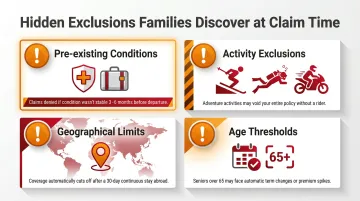
The most dangerous gaps hide in policy fine print, emerging only when families file claims. Watch for these four exclusion types:
- Pre-existing conditions: Travel and health policies often exclude conditions not stable for 3–6 months before purchase — making coverage worthless for families managing chronic health issues
- Activity exclusions: Skiing, diving, motorcycle use, and even some playground equipment may void accident coverage unless explicitly listed in the policy
- Geographical limits: Some travel policies cap trips at 30 days or exclude specific regions entirely
- Age thresholds: Coverage terms often change automatically when children or adults pass certain age milestones, with no notification from the insurer
How to Compare Family Insurance Offers and Optimize Your Coverage
What to Compare Beyond Price
Premium cost matters, but it's only one dimension of value. Forbrugerrådet Tænk uses a weighted comparison framework when testing Danish insurers:
| Criterion | Weight |
|---|---|
| Coverage scope and quality | 55% |
| Price and deductible | 35% |
| Customer satisfaction | 5% |
| Complaint resolution rate | 5% |
Deductibles (selvrisiko) directly affect out-of-pocket costs per claim. Increasing deductibles from 0 kr to 3,000 kr reduces premiums by an average of 24.4%, but means paying that amount before coverage begins.
Claims handling quality reveals itself through Ankenævnet for Forsikring data — the percentage of cases where consumers receive full or partial merit indicates whether an insurer processes claims fairly or fights legitimate requests.
Bundling discounts can reach 20% when consolidating multiple policies with one provider, but this doesn't always produce the cheapest total cost. Sometimes individual policies from different specialized insurers cost less.
When to Consolidate vs. Keep Separate Policies
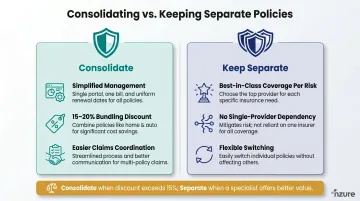
Consolidation advantages:
- Simplified management (one renewal date, one point of contact)
- Bundling discounts of 15-20%
- Easier claims coordination when multiple policy types are involved
Separate policy advantages:
- Access to best-in-class coverage for each risk category
- No risk of losing all coverage if one insurer relationship deteriorates
- Flexibility to switch individual policies as market conditions change
As a rule of thumb:
- Consolidate when bundling discounts exceed 15% and the primary insurer is competitive across all needed categories
- Keep separate when a specialist — for example, a dedicated travel insurer — offers meaningfully better coverage or pricing than your main provider
How Inzure Provides Ongoing Market Monitoring
One-time comparisons are a start, but continuous monitoring is what keeps loyalty penalties from creeping back in. Inzure tracks the Danish insurance market automatically and alerts you only when something worth acting on appears:
- Significant price-saving switch opportunities
- Coverage upgrades available at the same price
- Unwarranted premium increases from current insurers
This removes the burden of annual manual reviews while protecting against the creeping premium increases that cost loyal customers hundreds to thousands of kroner annually.
Frequently Asked Questions
What does a family insurance policy analysis actually include?
A comprehensive review of all household policies — home, contents, accident, travel, liability, and legal aid — identifying coverage gaps, duplicate premiums, and above-market pricing. The result is an action plan to optimize both protection and cost.
How often should a family review its insurance coverage?
Review at every major life event (new child, home purchase, job change, marriage, divorce) and at minimum once annually. Market prices and coverage terms change constantly, and loyalty does not guarantee competitive pricing.
What are the most expensive coverage gaps families typically discover?
Underinsured contents (often 50,000+ kr below actual value), children's accident coverage limited to home-only events, and duplicate travel insurance paid for through credit cards, memberships, and separate purchases. Each gap has a direct cost — either money wasted on overlapping cover or money lost when a claim falls short.
Is it possible to have too much insurance as a family?
Yes. Duplicate coverage across multiple policies — particularly travel insurance through credit cards, memberships, and separate purchases — is extremely common. Families often pay for identical protection two or three times without realizing it.
How do I know if my family is paying above the market rate for insurance?
The only reliable method is comparing your current premiums against live offers — either manually across multiple insurer websites or through an independent platform that monitors the full Danish market in real time. Without an active comparison, you have no reference point for what your policies should actually cost.
Can I analyze my family's policies without contacting my insurance provider?
Yes. Policy analysis can be done independently using existing policy documents. AI-powered tools perform this analysis automatically using uploaded PDFs or photos, requiring no provider contact and no obligation to switch.