
The stakes are higher than most realise. Switch too hastily and you risk coverage gaps that leave you exposed when you need protection most. Stay too long with your current provider and you'll likely fall victim to the loyalty penalty—a well-documented practice where long-term customers are quietly charged more than new customers for identical coverage. Research from the Danish Competition and Consumer Authority confirms that loyal customers generate 30-35 percentage points higher margins for insurers on home and contents policies.
This article walks through a clear set of priorities to follow before, during, and after changing insurance providers—so you can switch confidently and strategically, not just cheaply.
Key Takeaways
- Audit your current policy for gaps, duplicates, and what you're actually paying before comparing alternatives
- Compare like-for-like coverage, not just price — weak terms on a cheap policy will cost you more when a claim hits
- Time your switch to avoid mid-claim complications and cancellation fees
- Verify the new provider's claims track record using independent satisfaction scores
- Use an independent platform to see what the market actually charges for your specific coverage
Why People Switch Insurance Providers
The most common triggers for switching are straightforward:
- Unexplained premium increases at renewal
- Poor claims experiences
- Life changes like a new home or a growing family
- Discovering you've paid well above market rate for years
Inertia is the insurance industry's greatest asset. Most people stay put not because they're satisfied, but because switching feels unnecessarily complicated.
That inertia has a price. The loyalty penalty is real and widespread. Danish authorities confirmed in 2025 that insurers achieve significantly higher margins on loyal customers compared to newer ones, with the highest loyalty penalties reaching 30-35 percentage points for contents and home insurance. This happens through gradual price increases tied to wage indexation that loyal customers absorb without checking the market. Insurers reserve their most competitive pricing for acquisition, not retention.
A successful switch isn't just about finding the cheapest option. It means landing on a provider that delivers the right coverage at a fair price, with reliable service when it counts.
Top Priorities When Changing Insurance Providers
Switching without a clear checklist is how consumers end up with the same problems at a different company. The following priorities create a structured approach that protects coverage, avoids financial surprises, and ensures the switch delivers real value.
Understand Your Current Policy Before You Do Anything Else
You cannot meaningfully compare alternatives if you don't know exactly what you currently have. Many consumers are unaware of their deductibles, exclusions, coverage limits, and add-ons—meaning they risk unknowingly downgrading when they switch.
Retrieve your full policy documents and look specifically for:
- Coverage for fire, theft, water damage, and liability claims
- Exclusions — specific risks or circumstances the policy won't pay out for
- Your excess/deductible — what you pay out-of-pocket before coverage activates
- Bundled discounts that may disappear if you split policies across providers
Inzure's AI-powered policy analysis completes this audit in 60 seconds by reading your policy documents and surfacing coverage details, gaps, and overpayments automatically. This eliminates the manual work most people skip.
Compare Coverage First, Price Second
A policy that costs 20% less but excludes a key risk you actually face is not a saving—it's a liability. Meaningful comparison means matching coverage terms, limits, and exclusions across providers — not just monthly premiums.
How to do a like-for-like comparison:
- List your current coverage terms in detail
- Check each new quote against those exact terms
- Verify that specific risks are covered (water damage, personal liability, theft abroad)
- Compare excess amounts and coverage limits
- Only then compare price

Coverage for specific risks varies dramatically between providers at seemingly similar price points. The cheapest policy on paper often has the most restrictive exclusions.
Check for Coverage Gaps and Duplicate Policies
Two hidden problems catch consumers off-guard: gaps (situations you think are covered but aren't) and duplicates (paying twice for the same coverage through different policies).
Common examples of duplicates:
- Travel insurance included with premium credit cards and also purchased separately
- Personal liability covered under both home insurance and a standalone policy
- Accident coverage through both employer benefits and individual policies
Common coverage gaps:
- Missing partners or children from home, accident, or travel policies
- Underinsurance (covering less than 80% of replacement value)
- Exclusions for specific events you assume are covered
Map all your active policies before switching, checking for overlaps and missing protections. Done properly, this review often saves more money than the premium reduction alone — and produces coverage that actually matches your situation.
Time the Switch to Avoid a Coverage Gap
Cancelling a policy before the new one activates—even for a single day—leaves you uninsured. This is particularly risky for home and car insurance where continuous coverage may also be a legal or lender requirement.
Critical timing steps:
- Confirm the exact activation date of the new policy before cancelling the old one
- Check whether your current provider requires advance notice (typically 30 days in Denmark)
- Aim to switch at or near the renewal date to avoid early cancellation fees
- Never cancel until you have written confirmation the new policy is active
Mid-claim switching is especially problematic. If you have an open claim, wait until it's settled before switching providers.
Calculate the Real Cost of Switching
Switching is not always free. Danish insurers charge mid-term cancellation fees that can reach 800-900 kr per policy if you cancel within the first year. Some policies include loyalty discounts that disappear on cancellation, and bundled multi-policy deals often offer pricing that no single new policy can replicate.
Calculate the actual net saving:
New annual premium − cancellation fee − value of lost discounts = Net saving
Compare this against your current annual cost. If the net saving is small (under 1,000 kr), timing the switch to your next renewal date makes more financial sense.
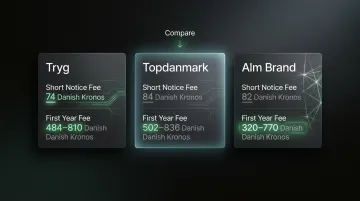
Sample cancellation fees for major Danish insurers:
- Tryg: 74 kr short-notice fee + 484-810 kr first-year fee
- Topdanmark: 84 kr short-notice fee + 502-836 kr first-year fee
- Alm. Brand: 82 kr short-notice fee + 320-770 kr first-year fee
Forbrugerrådet Tænk warns that bundle discounts often act as a smokescreen, making it difficult to compare actual prices. Their testing shows consumers often get better coverage by purchasing policies individually rather than relying on a bundle.
Evaluate the New Provider's Claims Process and Service Track Record
Insurance only matters when you actually need to make a claim. The quality and speed of the claims process is as important as the premium price. A cheaper provider with a poor claims reputation may cost more in stress, delays, and denied claims than a slightly pricier but reliable one.
Research these indicators:
- Claims settlement ratios or customer satisfaction scores
- Independent review platforms and consumer complaint data
- Ease of claims submission (digital vs. phone-only)
- Average processing times
The 2025 EPSI Rating for Danish non-life insurance shows significant variation in satisfaction scores: Vestjylland Forsikring scored highest (84.4) for private customers, while Tryg (68.0), Codan (68.2), and Topdanmark (70.4) all fell below the industry average of 72.5. For context on complaints, Ankenævnet for Forsikring data shows that Tryg and Topdanmark's high complaint volumes roughly reflect their market share — not necessarily worse performance per customer.